Read and export run evidence
A run's evidence reader collects its retained activity, development plan, task state, WAL and tool results. It returns a consistent cut with exact record references. Reading evidence does not execute commands, replay tools, resume a run or resolve an unknown outcome.
Start with a small page:
forge evidence query RUN_ID --limit 10
The response contains a manifest, its digest, a filter_digest, matching records and next_after. Keep both digests when requesting another page:
forge evidence query RUN_ID --expected-cut CUT_DIGEST \
  --expected-filter FILTER_DIGEST --after NEXT_AFTER --limit 10
Use --kind journal, --task-id implement or --text 'literal text' to narrow a query. Text matching is literal and local; it does not call a search provider or model. Filters never expand access to other runs or repositories. A preview reports payload_bytes and omitted_bytes. Read the exact record when the preview omits content:
forge evidence query RUN_ID --expected-cut CUT_DIGEST --record-id journal:3
The query and its output are bounded. Exact records can be at most 1 MiB. A page has at most 50 records and 1 MiB of JSON. The full cut permits 2,048 journal entries, 4,096 activity entries, 1,000 tool rows, 128 tasks, 128 artifact references and 16 MiB of source JSON, with a ten-second snapshot timeout. Each plan revision needs a distinct ordered WAL anchor, so plan history shares the existing journal capture budget and source JSON limit. Oversized or inconsistent evidence is withheld. A cut that changes before another page or export returns evidence_cut_changed; read a new cut explicitly. The server does not keep a separate history of these query snapshots.
Let an agent read its run history
A role with the read_run_evidence grant can inspect the executing run through Native Agentic or the bridge. The model receives a strict {"query": {...}} schema. Worker pages default to ten records and accept at most ten; the operator API retains its separate fifty-record page limit.
Unknown fields, invalid types, malformed JSON and incomplete pagination cursors return a fixed invalid_query tool result before the evidence service runs. That result contains no evidence and must not be treated as an empty page. The agent can correct the query within its existing request and tool-call budgets; the result remains compatible with checkpoint capture and restoration. A corrected query still passes the original run, identity and role checks. An authorization failure, inconsistent evidence or an unresolved effect stops execution; validation feedback grants no access or permission to replay work.
Export the reviewed cut
forge evidence export RUN_ID --expected-cut CUT_DIGEST --output run-evidence.zip
The output file must not already exist. The ZIP contains manifest.json, run.json, plan.json, tasks.json, activity.json, journal.json, tools.json and artifacts.json. The manifest lists each data member's byte length and SHA256. Its own digest seals its canonical JSON fields except digest; the HTTP X-Content-SHA256 header identifies the complete ZIP. Repeating an export of the same unchanged cut with the same Python/zlib runtime produces the same bytes. Entries use fixed timestamps, Unix file modes and empty comments/extra fields; compressed bytes are not promised identical across different compression implementations or versions.
The WAL retains its original payloads and chain hashes. Activity and task rows carry observed state; they do not become immutable receipts merely by appearing in an export. The plan includes an explicit projection and the original plan digest. An execution actor copied from the run is labeled observed_run_row rather than presented as an immutable historical attribution.
When a resume or provider selection creates another native plan revision, existing tasks can retain their original plan foreign keys. The reader checks every retained plan's native identity, run, revision, full-data digest and scope, then verifies its ordered WAL evidence. It keeps the initial immutable plan as the basis of plan.json and plan_digest; a later observed selection does not replace that anchor or rewrite task bindings.
For multiple revisions, the export also contains plans.json, and the manifest includes plan_history with the latest observed revision and each task's native plan binding. A plan whose complete digest appears in a matching plan WAL entry is labeled immutable_wal_plan, with full_plan_digest_in_wal: true. A native selection successor without that entry is labeled observed_native_plan_with_selection_handoff, with full_plan_digest_in_wal: false. That successor must preserve the preceding plan's task contract and match an ordered resume or handoff WAL entry for its previous and selected provider, configuration revision and model selection. This establishes native-row and selection-event lineage; it does not claim that the successor's complete contents were sealed by the WAL. Missing, changed, foreign or ambiguous lineage withholds the whole cut.
Plan history exports the same bounded plan projection as plan.json, excluding raw execution configurations. A single-plan run retains the existing manifest and ZIP member layout. Both forms are read-only observations with current access and credential checks; plan history grants no execution authority.
artifacts.json contains references. A reference is receipt_bound only when its SHA256 appears in a matching immutable receipt. Older changes.zip records have no historical byte hash and are labeled not_historically_bound. Their bytes are not copied, rebuilt or certified by this export. The existing source ZIP endpoint remains available separately.
Inspect native agent tool calls
In Run details > Plan, the write-ahead journal separates a tool call from its retained result. Each agent tool card names the operation, shows the exact model call ID and presents arguments and output as readable fields. Source text and patches use the existing code and diff views. The full canonical payload and its technical bindings remain under Advanced record.
Result retained means that the factory recorded the callback result. It does not mean that a business operation succeeded, a check passed or the product was accepted. An unavailable result stays visibly distinct. The factory does not repeat an uncertain callback automatically.
An intent links to a result only through its exact custody identity, model call, task, attempt, invocation, request step, argument digest, authority binding and original intent digest. Conflicting records require review. A similar tool name or nearby timestamp cannot supply a missing result.
Read complete provider activity
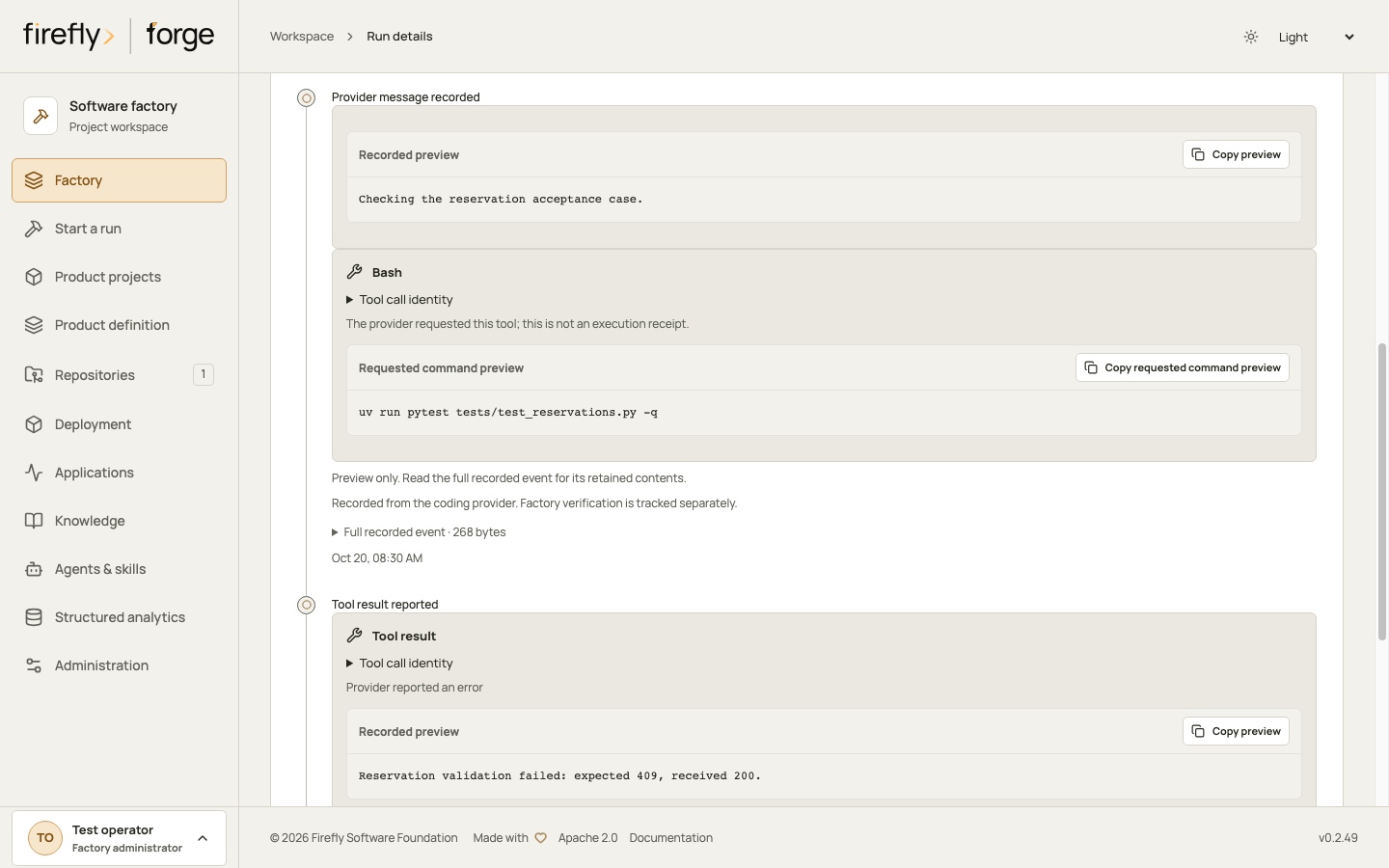
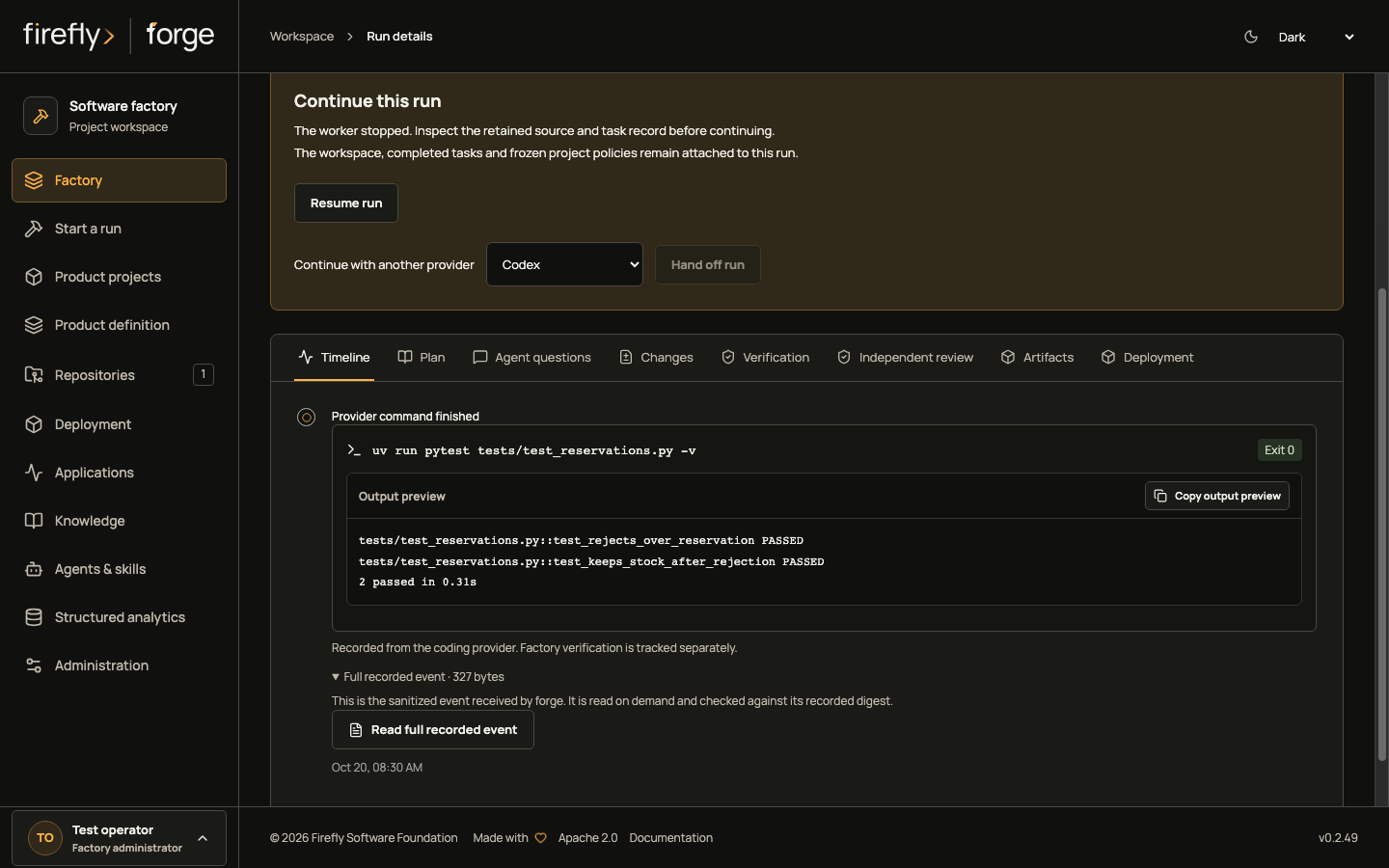
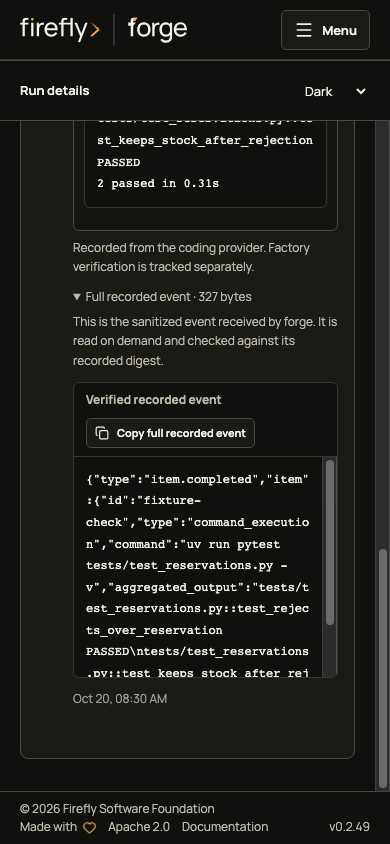
New stdout and stderr events retain a short preview and, for recognized provider JSON, a typed activity summary. Codex command records show their observed exit code and output. Claude records distinguish text, tool requests, reported tool results and final provider reports. Read full recorded event retrieves the retained sanitized message explicitly. Factory verification and product acceptance have their own records.
Codex MCP cards name the server and tool and show whether the provider reported an in-progress call, completion or failure. A bounded text preview and a reported exit code appear when the event supplies them. Completion is a provider report; it does not establish a native runner receipt or product QA. Arbitrary tool arguments and unsupported structured results stay in the full retained event. The native journal labels the separately governed coding_configured_check tool Run configured project check.
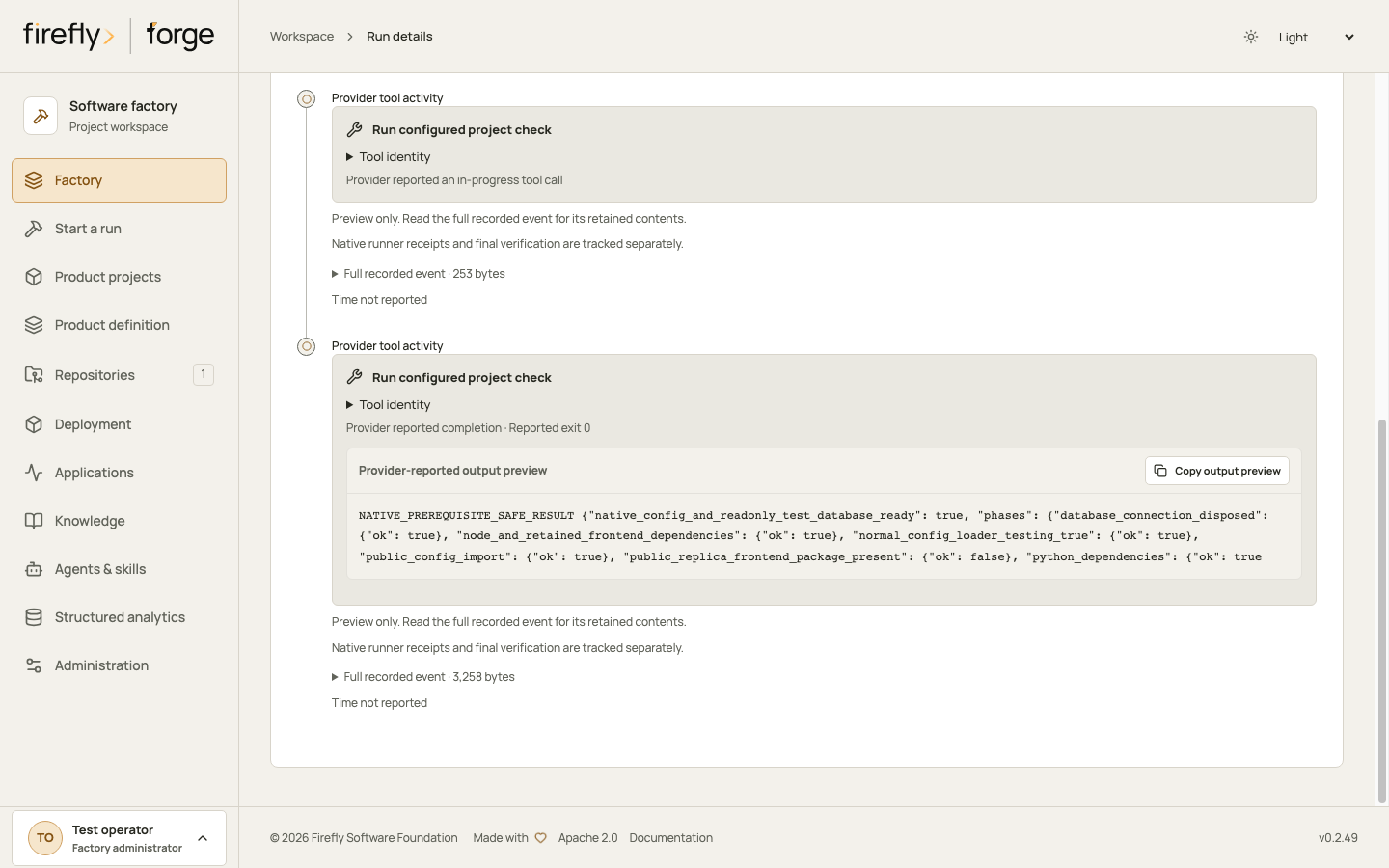
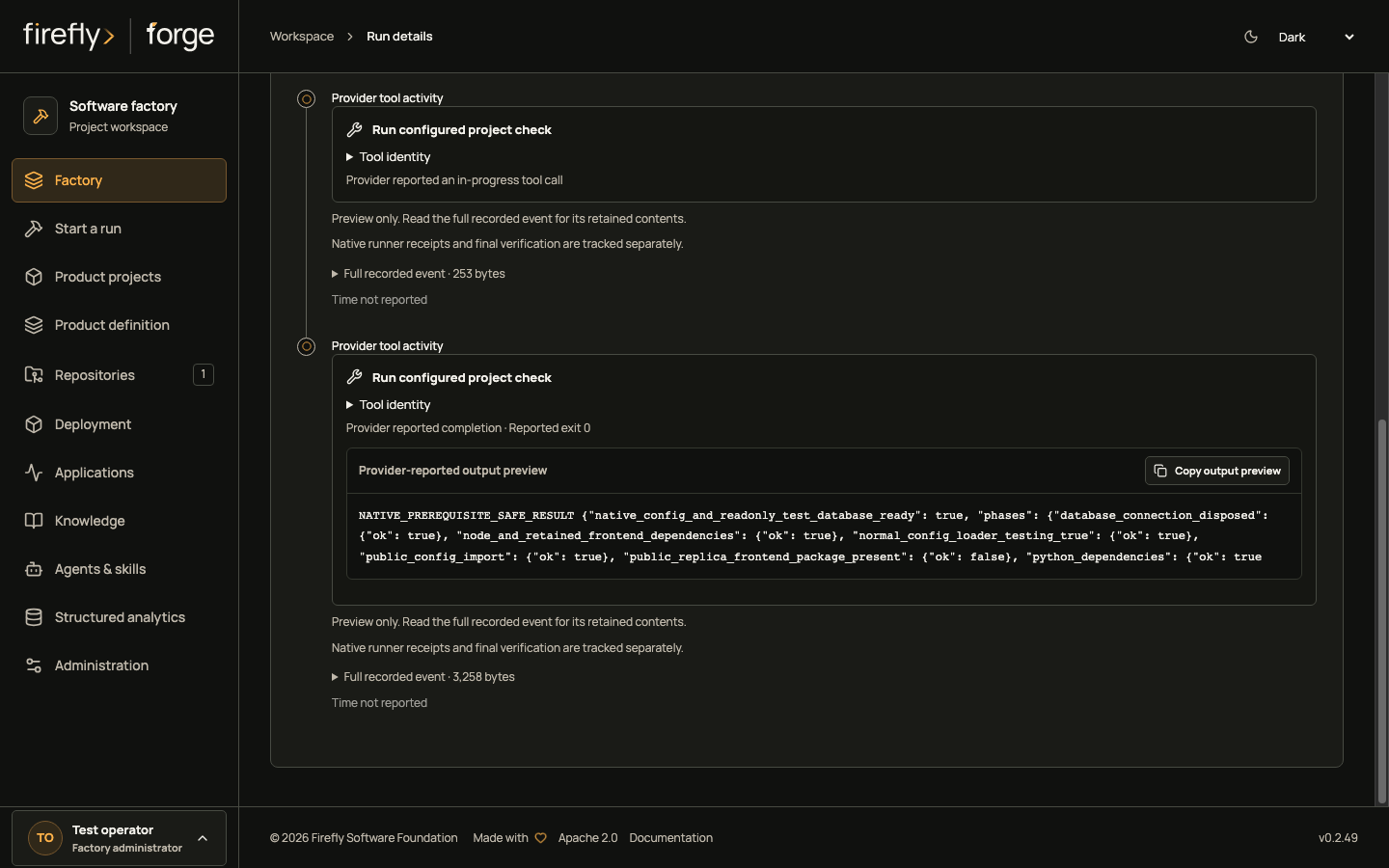
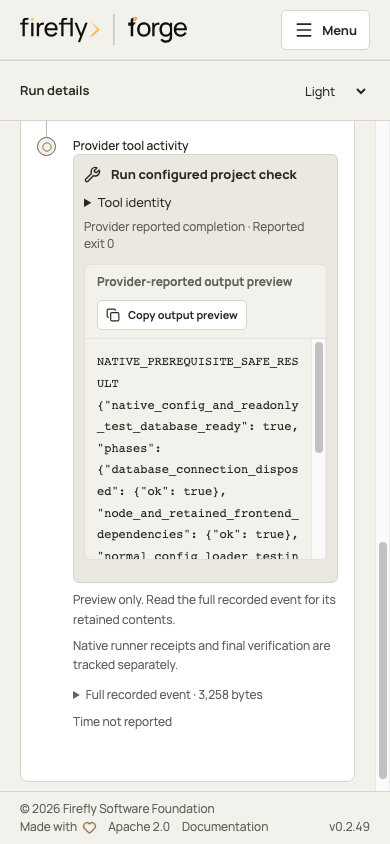
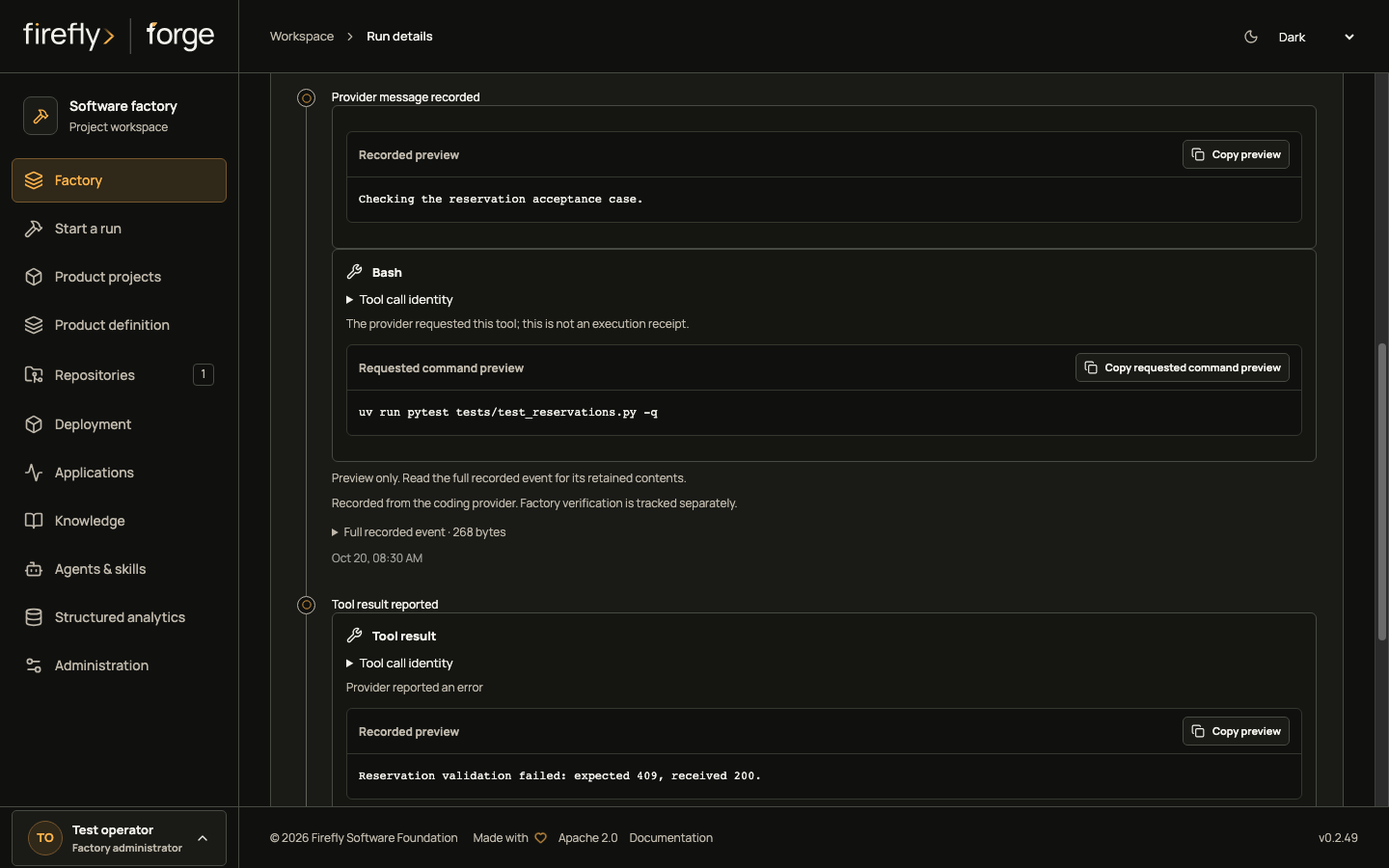
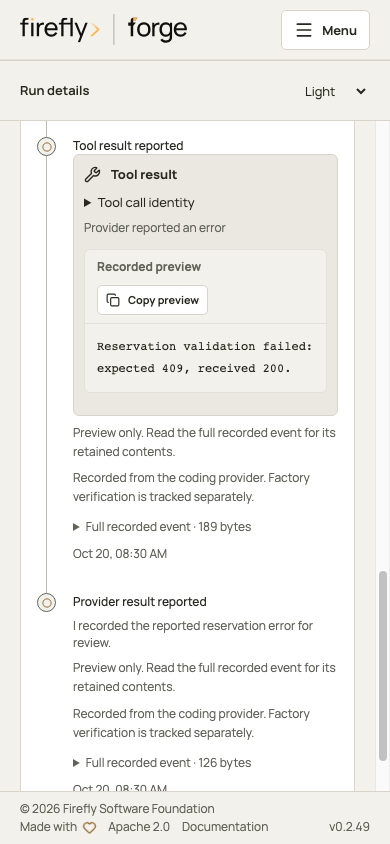
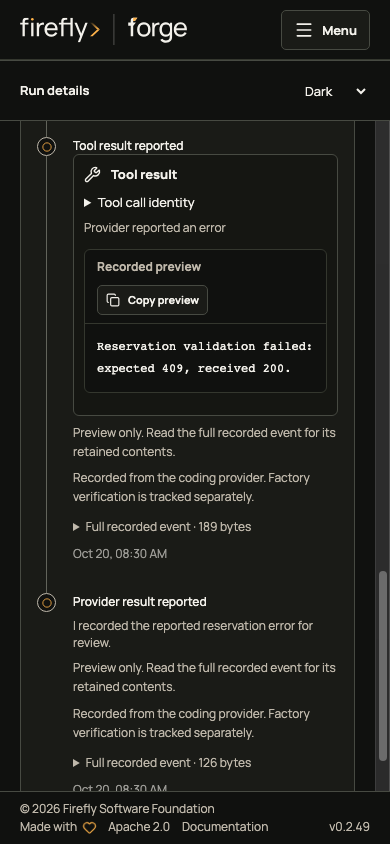
Claude tool requests name the requested tool and show a Bash command preview when available. A request does not prove that a tool ran. Tool-result cards show the provider's reported result or error without deriving an exit code, and keep the original call ID under Tool call identity. forge does not infer a tool name from another event. A successful final provider report supplies no factory QA approval.
A Claude message can contain several content blocks. Studio displays up to four bounded blocks and states how many blocks were omitted from the preview. When the archive retained the full event, you can read those blocks there. An archive-limit notice means only the preview was retained. Tool input objects, attachments and unsupported block formats stay in the retained event. Unknown, malformed or oversized JSON previews receive a short generic card; plain text logs remain readable. Full content is loaded only when requested and within its archive budget. These display rules recognize an observed JSON format; they do not authenticate the provider or replace a command receipt.
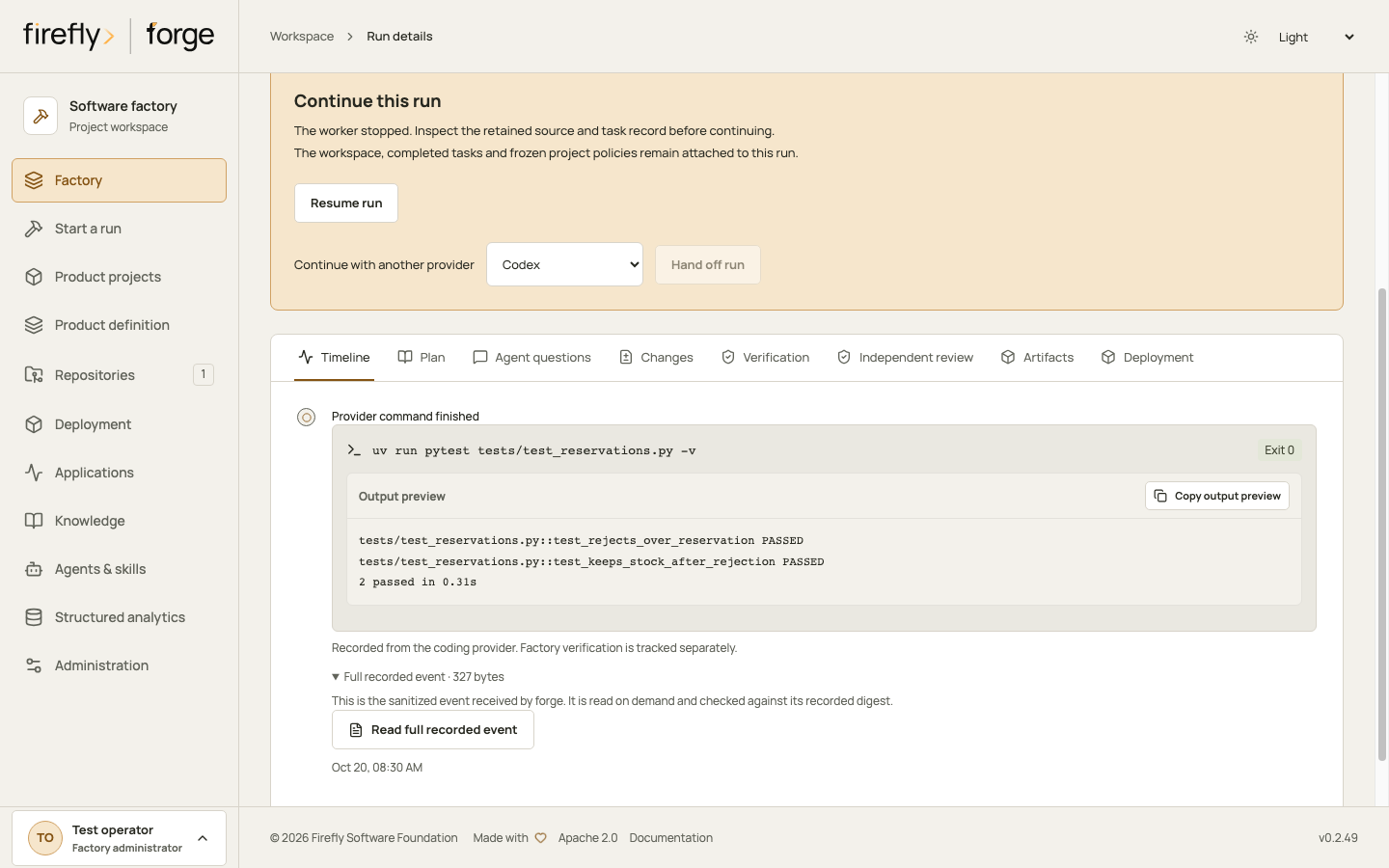
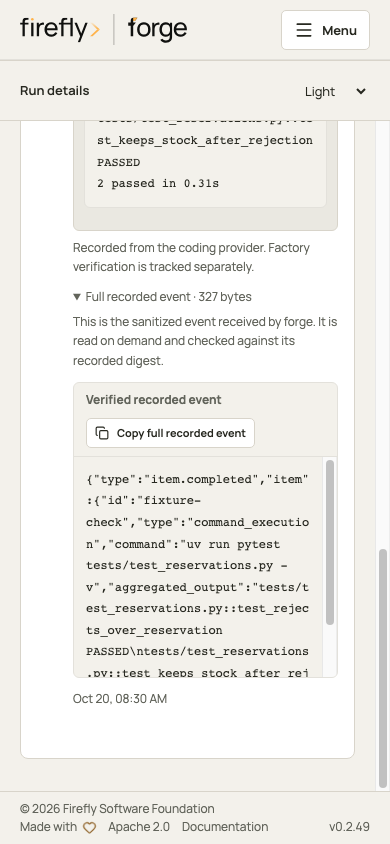
Each new event carries an activity_content descriptor binding the run, event, stage, byte count and sanitized-message SHA256. Available content is limited to 4 MiB per message, 64 MiB and 4,096 messages per run. budget_exceeded means the full message was not retained. Historical events are not backfilled. D04 run-evidence pages and ZIP exports retain only the activity index and bound descriptors; they exclude complete content bytes and keep their existing limits.
Read one available message using its exact descriptor:
forge evidence activity RUN_ID EVENT_ID --expected-descriptor DESCRIPTOR_SHA256 --chunk 0
HTTP uses GET /api/v1/runs/{run_id}/activity/{event_id}/content with expected_descriptor and chunk. The SDK method is ForgeClient.run_activity_content(run_id, event_id, query); MCP exposes get_run_activity_content. Each response returns at most 16 KiB in data_base64, with byte offset, total size, sanitized-message digest and next_chunk. Follow that ordinal until null, concatenate decoded bytes, and verify the complete size and SHA256 before decoding UTF-8: a character may span chunks.
Every chunk requires current native read authority over the run's repository and frozen project scope, and checks the whole retained message for newly registered credentials. Revocation, descriptor or scope changes, missing or corrupt content and exhausted budgets withhold content with an explicit error. Private responses are not cacheable. These reads do not replay commands or change a run's verification state.
Current access and withheld evidence
The reader needs a current native identity, project read permission and read access to all historical repositories named by the verified project revision. Unassigned executions require a factory administrator. A delegated SCM status or answer permission does not grant evidence export.
Forge checks current credentials before returning a page or download and rechecks access afterward. A newly registered credential in retained output causes the evidence to be withheld; the original sealed payload stays unchanged. Credential admission failure, a revoked reader, integrity errors or timeout cannot yield a partially verified download. The service refuses calls made inside an existing transaction so credential checks do not wait while that caller holds database locks.
Agents and clients
ForgeClient.run_evidence and export_run_evidence use the same authenticated endpoints. The factory MCP tool query_run_evidence supports the typed query, including exact record reads.
The native Agentic tool read_run_evidence is an explicit implementation-stage role grant for API and Bridge workers. Existing default workspace grants stay unchanged. Its callback is bound to the current run and task by the server, checks that task's frozen grant, the original execution identity and current read permissions, and limits output to ten records and 32 KiB. It accepts no alternate actor, project, run or task. Independent review and design providers do not receive this callback. Larger records remain available to authorized operators through the bounded HTTP reader. The reader does not invoke ToolBroker callbacks. In a captured native Agentic invocation, the outer capability records the exact call intent before the reader opens its snapshot and retains the result after that snapshot closes. The returned cut can contain its intent, but cannot contain its own later result. Reading a record does not execute its original tool.
An evidence export describes the retained records and their stated verification boundary. It does not establish live provider execution, certify unbound artifact bytes or restore an interrupted Agentic graph.