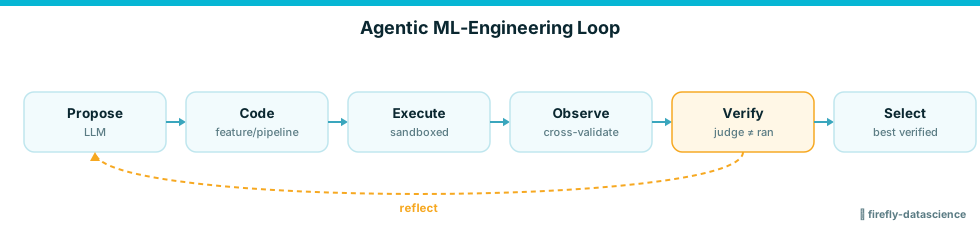
Agentic ML-engineering loop
An LLM proposes, the classical engine decides — a deterministic verifier, not "it ran", is the judge.
The agentic loop realizes the SOTA AutoML pattern grounded on a deterministic executor: an LLM proposes a solution (a trainer plus hyperparameters), the classical engine trains and cross-validates it, and a Verifier — a stage distinct from execution-success — decides whether the result is genuinely good. Search is greedy with reflection over the attempt history, bounded by an iteration and patience budget.
The whole cycle is propose → train/CV → verify → reflect → select.
The recurring pattern — the LLM proposes; the classical engine decides
The LLM never gets the last word. It suggests the next (trainer, params) candidate; the
classical engine cross-validates it and a deterministic Verifier rules on whether it actually
beats a trivial baseline. A candidate that runs but fails to clear the baseline is rejected — so
the loop can only ever return a model that measurably earned its place.
The pieces
| Type | Role |
|---|---|
SolutionCandidate |
A proposal: trainer, params, rationale. |
Verdict |
The verifier's judgement: valid, reason, score. |
AttemptRecord |
One iteration: candidate, score, verdict. |
EngineeringRun |
The full trace of a run, plus the fitted best model. |
AgenticAutoML |
The loop engine (AgenticLoopPort). |
DeterministicVerifier |
Correctness check: finite + beats the trivial baseline. |
AgentSolutionProposer |
LLM-backed proposer (reflects via a FireflyAgent). |
SequenceProposer |
Deterministic proposer for tests / fixed strategies. |
SolutionCandidate, Verdict, and AttemptRecord are frozen dataclasses; EngineeringRun carries
the trace and the refit model. The two proposers both satisfy the CandidateProposer protocol, and
DeterministicVerifier satisfies the Verifier protocol — so any of them can be swapped for a custom
implementation.
Quick start
AgenticAutoML takes any proposer and runs the loop over a Dataset:
from fireflyframework_datascience.datasets import Dataset
from fireflyframework_datascience.engineering import SolutionCandidate, SequenceProposer
from fireflyframework_datascience.engineering.loop import AgenticAutoML

dataset = Dataset.from_frame(df, target="churned")

proposer = SequenceProposer([
    SolutionCandidate("linear"),
    SolutionCandidate("random_forest", {"n_estimators": 300}),
    SolutionCandidate("hist_gradient_boosting", {"learning_rate": 0.05}),
])

loop = AgenticAutoML(proposer, max_iterations=8, patience=3, cv=5)
run = loop.solve(dataset)

print(run.summary())
Expected
The engine seeds the candidates from propose_initial, then repeatedly calls propose_next until a
candidate is None, the iteration budget is spent, or patience runs out.
propose → train/CV → verify → reflect → select
The engine never trusts a candidate just because it executed. Each attempt is:
- propose — the proposer yields a
SolutionCandidate. - train / CV — the candidate is wrapped in a preprocessing pipeline and scored with
sklearn'scross_val_score(defaultcv=5). A failing candidate scores-infand never aborts the loop. - verify — the
Verifierturns a raw score into aVerdict. Onlyvalidverdicts can become the best. - reflect —
propose_nextis handed the fullhistoryto inform the next proposal. - select — the highest-scoring verified candidate wins and is refit on all data.
for candidate in self._proposer.propose_initial(dataset, names):  # (1)!
    record = self._attempt(dataset, candidate, task, scoring, baseline)  # (2)!
    attempts.append(record)
    if record.verdict.valid and record.score > best_score:  # (3)!
        best, best_score = candidate, record.score

patience = self._patience
for _ in range(self._max_iterations):
    candidate = self._proposer.propose_next(dataset, attempts, names)  # (4)!
    if candidate is None:
        break
    record = self._attempt(dataset, candidate, task, scoring, baseline)
    attempts.append(record)
    if record.verdict.valid and record.score > best_score:
        best, best_score, patience = candidate, record.score, self._patience  # (5)!
    else:
        patience -= 1
        if patience <= 0:
            break
- Seed —
propose_initialreturns the starting population, evaluated before any reflection. - Train / CV + verify —
_attemptcross-validates the candidate and asks theVerifierfor aVerdictin one step. - Select — only a
validverdict that improves on the running best can take the lead. - Reflect —
propose_nextreceives the fullattemptshistory; a returnedNoneends the loop. - Patience reset — an improving verified attempt restores the full patience budget; a non-improving one decrements it, stopping the loop at zero.
DeterministicVerifier — correctness, not execution
A run that produces a number is not the same as a run that produced a good number.
Correctness ≠ ran
A candidate that trained and returned a score has only proven it executed. Verification is a
separate stage: DeterministicVerifier demands a finite score that beats the trivial
baseline by a margin. Anything else is rejected — execution-success is never mistaken for
correctness.
DeterministicVerifier requires a finite score that beats the trivial baseline (a DummyClassifier
with strategy="prior" / DummyRegressor with strategy="mean") by a margin:
from fireflyframework_datascience.engineering.loop import DeterministicVerifier

verifier = DeterministicVerifier(margin=0.01)   # must beat baseline by at least 0.01
loop = AgenticAutoML(proposer, verifier=verifier)
Verdicts read like a review:
Verdict(valid=False, reason="training failed or produced a non-finite score", score=-inf)
Verdict(valid=False, reason="does not beat the trivial baseline (0.5010 <= 0.5000)", score=0.5010)
Verdict(valid=True,  reason="beats trivial baseline by +0.4123", score=0.9123)
You can supply any object implementing the Verifier protocol
(verify(dataset, candidate, score, baseline) -> Verdict).
Proposers
Both built-in proposers satisfy the CandidateProposer protocol — pick the LLM-backed one for real
search, or the deterministic one for tests and fixed strategies.
AgentSolutionProposer seeds every trainer at its defaults, then reflects on the ranked history
via a FireflyAgent. The LLM client is built lazily on first reflection — no client is created at
startup:
from fireflyframework_datascience.engineering.loop import AgenticAutoML, AgentSolutionProposer

proposer = AgentSolutionProposer(model="openai:gpt-4o")
run = AgenticAutoML(proposer, max_iterations=10).solve(dataset)
On each propose_next, the agent receives the task, the allowed trainers, and the best-first
attempt history (top 8), and returns a structured (trainer, params_json, rationale). If the
model names a trainer outside the allowed list, the proposer falls back to the best trainer seen so
far; malformed params_json degrades to {}. You can also inject a pre-built agent with
AgentSolutionProposer(agent=my_agent).
For tests or fixed search plans, SequenceProposer replays a fixed candidate list — the first is
the seed, the rest are dispensed one per propose_next:
To write your own, implement the CandidateProposer protocol: propose_initial(dataset, trainers)
and propose_next(dataset, history, trainers).
Which trainers are allowed
The trainers list a proposer sees comes from the loop's registry. By default that is linear,
random_forest, and hist_gradient_boosting, plus xgboost, lightgbm, and catboost when
those optional libraries are installed. Pass trainers=... to AgenticAutoML to constrain or
extend the search space.
The EngineeringRun trace
solve returns an EngineeringRun — a full, auditable trace plus the refit best model:
run = loop.solve(dataset)

run.best_candidate      # SolutionCandidate | None
run.best_score          # float (nan if nothing verified)
run.model               # the refit Model (None if nothing verified)
run.metric              # e.g. "roc_auc"
run.baseline_score      # the trivial baseline it had to beat
run.n_iterations        # total attempts
run.valid_attempts      # only the verified ones

for a in run.attempts:
    print(a.candidate.trainer, a.score, a.verdict.valid, a.verdict.reason)
n_iterations and valid_attempts are derived from attempts, and summary() renders the one-line
recap shown under Quick start.
Budgets: iterations and patience
The loop is greedy with two knobs:
max_iterations(default8) — the hard cap on reflection rounds after seeding.patience(default3) — consecutive non-improving attempts allowed before early stopping.
Each improving verified attempt resets patience to the full budget; each non-improving one decrements it, and the loop stops when it hits zero. Tune the trade-off between thoroughness and cost:
loop = AgenticAutoML(
    proposer,
    cv=5,
    max_iterations=12,   # explore more
    patience=4,          # tolerate more dead ends
    random_state=42,
)
Patience only counts after seeding
The initial population from propose_initial is always fully evaluated; patience and
max_iterations bound only the reflection rounds that follow. A run with an empty or trivial seed
still respects the iteration budget.
See also
- Datasets — the
Datasetthe loop searches over. - AutoML — the trainer registry, metrics, and the preprocessing pipeline wrapped around every candidate.
- GenAI features — other places the LLM proposes and the classical engine decides.
- LLM configuration — wiring the model behind
AgentSolutionProposer. - Architecture — the ports and adapters the loop plugs into.