Classical AutoML
Cross-validate a panel of tabular models, tune the contenders, and fit the winner — in three lines.
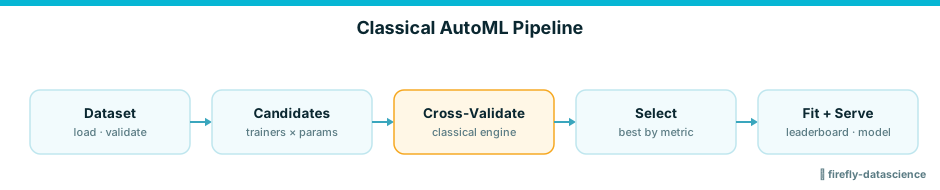
The AutoML engine is the front door of Firefly DataScience. It validates a dataset, cross-validates every
trainer that supports the task (optionally tuning each one), and returns a fitted winner together with the full
leaderboard. It is import-light: scikit-learn is only loaded when you actually call fit, so
from fireflyframework_datascience.automl import AutoML stays cheap.
The LLM proposes; the classical engine decides
AutoML is pure classical machine learning — deterministic, seeded, and reproducible. Where GenAI
enters elsewhere in the framework, it only ever proposes (seeds, bounds, candidate features);
this engine decides by cross-validated score. The search is owned by Optuna and scikit-learn,
never by a language model.
Quick start
from fireflyframework_datascience.automl import AutoML
from fireflyframework_datascience.datasets.adapters import SklearnDatasetLoader

dataset = SklearnDatasetLoader().load("breast_cancer")
train, test = dataset.train_test_split(test_size=0.25)

result = AutoML().fit(train)            # task & metric inferred from the dataset

print(result.best_model.name)           # e.g. "hist_gradient_boosting"
print(result.leaderboard_table())
print(result.evaluate(test))            # EvaluationResult on held-out data
fit infers the task from dataset.task and the default metric from the evaluator (roc_auc for binary,
accuracy for multiclass, rmse for regression). Override either explicitly:
from fireflyframework_datascience.core.types import TaskType

result = AutoML().fit(train, task=TaskType.BINARY, metric="f1")
The fit loop
For each trainer that supports(task), AutoML:
- Builds the trainer's hyperparameter search space — but only when
n_trials > 1; withn_trials <= 1the space is empty and the search collapses to a single default-hyperparameter evaluation. - Runs the search policy, whose objective wraps the estimator in a preprocessing pipeline and
cross-validates it (
cross_val_score,cvfolds). - Records a
LeaderboardEntrywith the best CV score. - After all candidates are scored, refits the highest-scoring trainer on the full training data and
wraps it as a
Model.
space = trainer.param_space(task) if n_trials > 1 else {}   # (1)!
result = search_policy.optimize(objective, space, n_trials=n_trials, seed=random_state)  # (2)!
leaderboard.append(LeaderboardEntry(trainer.name, dict(result.best_params), result.best_score, metric))
if best is None or result.best_score > best[0]:             # (3)!
    best = (result.best_score, trainer, dict(result.best_params))
- No tuning budget means no space to search — the policy evaluates the estimator's defaults once.
- The CV objective returns the mean fold score. A candidate that raises during CV is logged and scored
-inf, so one broken estimator never aborts the whole run. - Selection is strictly by CV score (greater is better, always). The winning trainer is then refit on
dataset.X, dataset.yinside the same preprocessing pipeline.
The preprocessing pipeline is built automatically from the column dtypes: numeric columns get median
imputation + StandardScaler; categorical columns get most-frequent imputation + OneHotEncoder
(handle_unknown="ignore"). Scaling is harmless for trees and essential for linear models, so the same
pipeline serves every trainer.
Configuring the engine
from fireflyframework_datascience.automl import AutoML
from fireflyframework_datascience.models.adapters import (
    RandomForestTrainer,
    HistGradientBoostingTrainer,
    XGBoostTrainer,
)
from fireflyframework_datascience.search.adapters import OptunaSearchPolicy

automl = AutoML(
    trainers=[RandomForestTrainer(), HistGradientBoostingTrainer(), XGBoostTrainer()],
    search_policy=OptunaSearchPolicy(),
    cv=5,
    n_trials=40,
    random_state=42,
)
result = automl.fit(train)
The constructor accepts trainers, evaluator, search_policy, validator, tracker, plus the
cv, n_trials, and random_state knobs (defaults cv=5, n_trials=20, random_state=42). Anything
left as None falls back to sensible defaults: [RandomForestTrainer(), LinearTrainer(), HistGradientBoostingTrainer()],
the SklearnMetricsEvaluator, and the DefaultSearchPolicy. A validator and tracker stay None
unless you supply them — when present, the validator runs first and raises on failure, and the tracker
logs the winner's params, CV score, and model artifact.
cv accepts a splitter, not just a fold count
cv is passed straight to scikit-learn's cross_val_score, so beyond an int you can hand it any
splitter to control how folds are drawn — and to avoid silent leakage:
from sklearn.model_selection import TimeSeriesSplit, GroupKFold, StratifiedKFold

AutoML(cv=TimeSeriesSplit(n_splits=5))          # temporal data: forward-chaining, no future leakage
AutoML(cv=StratifiedKFold(5, shuffle=True))     # explicit stratification + shuffling control
AutoML(cv=GroupKFold(n_splits=5))               # grouped data: keep a group out of train and test
The same splitter drives every candidate's cross-validation, so the leaderboard stays comparable.
Wiring it up
Construct the engine by hand and call fit directly — ideal for exploration:
In an application, resolve the components from a started ApplicationContext instead of wiring
them by hand:
from_context pulls every registered TrainerPort from the container and resolves the optional
evaluator, search policy, validator, and tracker. Keyword overrides win over the resolved
components, and missing evaluator/search policy fall back to the same defaults as the constructor.
Trainers
Each trainer is a thin adapter that builds an unfitted estimator and declares a ParamSpace. All of them
support classification and regression and select the right estimator class per task.
| Trainer | name |
Estimator (clf / reg) | Extra dependency |
|---|---|---|---|
RandomForestTrainer |
random_forest |
RandomForest{Classifier,Regressor} |
— (sklearn) |
LinearTrainer |
linear |
LogisticRegression / Ridge |
— (sklearn) |
HistGradientBoostingTrainer |
hist_gradient_boosting |
HistGradientBoosting{Classifier,Regressor} |
— (sklearn) |
XGBoostTrainer |
xgboost |
XGB{Classifier,Regressor} |
xgboost |
LightGBMTrainer |
lightgbm |
LGBM{Classifier,Regressor} |
lightgbm |
CatBoostTrainer |
catboost |
CatBoost{Classifier,Regressor} |
catboost |
The boosting-library trainers (xgboost, lightgbm, catboost) import their backend lazily, so you only
pay for the extra you install. A trainer exposes three methods used by the engine:
trainer.supports(task)                 # -> bool
trainer.make_estimator(task, params)   # -> unfitted estimator (sensible defaults merged with params)
trainer.param_space(task)              # -> ParamSpace
Defaults are baked in, not magic
make_estimator merges your params over each trainer's defaults — for example RandomForestTrainer
starts from n_estimators=200, n_jobs=-1, random_state=42, and HistGradientBoostingTrainer from
learning_rate=0.1, max_iter=200, random_state=42. The param_space only widens the dimensions worth
tuning (e.g. n_estimators, max_depth, max_features for random forest).
Search policies
A search policy optimizes the cross-validation objective over a trainer's ParamSpace. Scores are always
"greater is better" (the evaluator maps loss-style metrics to negated sklearn scorers).
DefaultSearchPolicy(name="default") evaluates the estimator's default hyperparameters once — fast and fully deterministic. This is the engine default, and it reportsn_trials=1.OptunaSearchPolicy(name="optuna") runs seeded Bayesian optimization (TPE). The space spec drives the suggestions; if the space is empty it degrades to a single default evaluation (n_trials=1).
from fireflyframework_datascience.search.adapters import OptunaSearchPolicy
from fireflyframework_datascience.tuning import IntParam, FloatParam, CategoricalParam

space = {
    "n_estimators": IntParam(100, 500, step=50),
    "max_depth": IntParam(3, 24),
    "max_features": CategoricalParam(("sqrt", "log2", None)),
}
result = OptunaSearchPolicy().optimize(objective, space, n_trials=40, seed=42)
print(result.best_params, result.best_score, result.n_trials)
Both policies return a SearchResult(best_params, best_score, n_trials). The seeded TPE sampler
(TPESampler(seed=seed)) keeps the search reproducible — classical HPO owns the search, not an LLM.
Metrics
The default SklearnMetricsEvaluator (name="sklearn") supplies CV scoring names and a panel of held-out
metrics:
- Classification:
accuracy,f1(weighted),precision(weighted),recall(weighted), plusroc_aucandlog_losswhen probabilities are available. For binary tasks the panel also reportsaverage_precision(PR-AUC) andbrier_score(probability quality / calibration). - Regression:
rmse,mae,r2.
ev = result.evaluator
ev.default_metric(result.task)        # "roc_auc" for binary, "accuracy" multiclass, "rmse" regression
ev.scoring_name(result.task, "f1")    # "f1_weighted" (the CV scorer)
ev.greater_is_better("rmse")          # False
The leaderboard and CV objective use the scoring name, not the raw metric: f1 maps to the
f1_weighted scorer, rmse to neg_root_mean_squared_error, and binary roc_auc stays roc_auc while
multiclass roc_auc becomes roc_auc_ovr_weighted. This is why CV scores are always maximized — a lower
RMSE shows up as a larger (less negative) neg_root_mean_squared_error.
Select on PR-AUC for imbalanced binary problems
ROC-AUC over-credits a classifier on heavily imbalanced data. Pass metric="average_precision" to
select the winner on PR-AUC instead — it is a first-class CV scorer, so the leaderboard, the
refit winner, and result.cv_scoring all reflect it:
Two scores, one winner
result.metric is the human-facing metric name (e.g. roc_auc); result.cv_scoring is the sklearn
scoring string actually used for cross-validation. The leaderboard's cv_score is the mean CV score
under that scorer, and evaluate(test) recomputes the full panel on held-out data.
The AutoMLResult API
fit returns an AutoMLResult carrying the fitted winner, the sorted leaderboard, and the evaluator used:
result.best_model        # Model: name, estimator, task, feature_names, params
result.best_score        # leaderboard[0].cv_score (the top CV score)
result.leaderboard       # list[LeaderboardEntry] sorted best-first
result.metric            # primary metric name
result.task              # TaskType
result.cv_scoring        # sklearn scoring string used during CV

result.predict(test.X)               # winner predictions
result.predict_proba(test.X)         # class probabilities (classification)
eval_result = result.evaluate(test)  # EvaluationResult on a held-out Dataset
print(eval_result.primary_metric, eval_result.primary_value)

print(result.leaderboard_table())    # one line per candidate
Each LeaderboardEntry holds model_name, params, cv_score, and metric, and prints as a tidy
model_name metric=score line (the name is left-padded to 24 columns, the score to 4 decimals).
best_score is a property that reads the top entry, so it always agrees with the first row of the table.
evaluate automatically passes probabilities through for classification when the winning estimator exposes
predict_proba.
Expected
result.leaderboard_table() on the breast-cancer quick-start prints one line per candidate, sorted
best CV score first. Each line is the LeaderboardEntry.__str__ format — the trainer name
left-padded to 24 columns, then metric=score to 4 decimals (values vary slightly by environment
and library versions):
Probability calibration
Tree and boosting models often produce over-confident probabilities. For risk- or cost-sensitive
decisions, calibrate the winner so its probabilities are trustworthy — pass calibrate=True:
result = AutoML(calibrate=True).fit(train)        # wraps the winner in cross-validated calibration
report = result.evaluate(test)
print(report.metrics["brier_score"])              # lower is better-calibrated
calibrate wraps the selected classifier in a CalibratorPort (default: scikit-learn
CalibratedClassifierCV, isotonic, cross-fit) after model selection — classification only, off by
default. The evaluator also reports average_precision (PR-AUC, important on imbalanced data) and
brier_score (probability quality) for binary tasks alongside roc_auc/accuracy.
Ensembling
Single-best selection leaves accuracy on the table. Pass ensemble=True to stack the top-k
leaderboard candidates into one model via a cross-fit meta-learner:
result = AutoML(ensemble=True, ensemble_size=3).fit(train)
print(result.best_model.name)              # "stacking_ensemble"
print(result.best_model.params["members"]) # the base learners that were stacked
The winner becomes an EnsemblePort (default: scikit-learn StackingClassifier/StackingRegressor
over the top-ensemble_size trainers, with a logistic / ridge meta-learner). Off by default;
ensemble and calibrate compose (the stack can itself be calibrated). DI-resolvable via from_context.
See also
- Datasets and loaders — build the
Datasetyou feed tofit. - GenAI + classical fusion — how the LLM proposes and this engine decides.
- The agentic loop — the cost-benefit gate around GenAI proposals.
- Serving the winner — deploy
result.best_model. - Benchmarks — measured leaderboard results on real datasets.