GenAI Feature Engineering
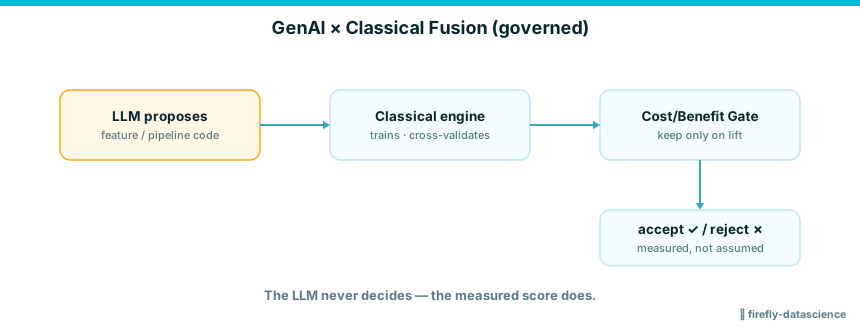
The LLM proposes feature code; classical cross-validation decides what survives.
Firefly DataScience treats generative AI as a proposer, never a judge. A language model
suggests pandas snippets that add new columns; a deterministic engine measures the
cross-validation lift of each one, and a CostBenefitGate keeps a feature only if it
beats the current baseline by a measurable margin. The LLM never touches the score — it
just generates candidates, and the data does the rest.
Wired into AutoML
When a FeatureEngineerPort is present in the container (i.e. GenAI is enabled),
AutoML.from_context(app) runs this propose → execute → measure → gate loop
before model selection and trains on the engineered features — the gate's accepted/rejected
audit is threaded into result.extras["feature_engineering"]. Classical-first stays the default:
with GenAI off, AutoML is unchanged.
The loop
GenAIFeatureEngineer runs propose → execute → measure → gate:
- Propose — a
FeatureProposerreturns a list ofFeatureProposals (name,code,rationale). - Execute —
FeatureCodeExecutorstatically vets and safely runs each snippet against a copy of the frame. - Measure — a classical estimator scores the candidate frame via cross-validation.
- Gate —
CostBenefitGateaccepts the feature only if the score improves by more thanmin_gain.
Each accepted feature is folded into the working frame, so the next proposal is measured against the improved baseline — features must earn their keep on top of everything kept so far. Everything is injectable, so the loop runs fully offline with a stub proposer — no LLM required for tests.
The cost-benefit gate — GenAI proposes, the measured score decides
CostBenefitGate is the governance primitive that keeps GenAI honest. It compares the
candidate score against the current best and accepts only a strict improvement beyond
min_gain:
With the default min_gain=0.0, any strict improvement is kept; raise it to demand
features that clear a meaningful bar before they earn their complexity. A proposal that
does not measurably beat the seeded classical baseline is rejected — the LLM never
overrides the data.
Quick start
Pick a proposer: a deterministic StaticFeatureProposer for known features and LLM-free
runs, or an AgentFeatureProposer that asks a model for candidates.
StaticFeatureProposer drives the loop with a fixed, known set of features — ideal for
tests, reproducible pipelines, and codifying domain knowledge.
from fireflyframework_datascience.features import FeatureProposal, StaticFeatureProposer
from fireflyframework_datascience.features.genai import GenAIFeatureEngineer

proposer = StaticFeatureProposer([
    FeatureProposal(
        name="income_per_dependent",
        code="df['income_per_dependent'] = df['income'] / (df['dependents'] + 1)",
        rationale="Normalises income by household size.",
    ),
    FeatureProposal(
        name="utilization",
        code="df['utilization'] = df['balance'] / (df['credit_limit'] + 1)",
        rationale="Classic credit-risk ratio.",
    ),
])

engineer = GenAIFeatureEngineer(proposer, cv=5, max_features=5)
result = engineer.engineer(dataset)
print(result.summary())
AgentFeatureProposer wraps a FireflyAgent from fireflyframework-agentic. It sends the
schema, a few sample rows, and the task to the model, then maps the structured output to
FeatureProposals. The agent is built lazily on first use, so no LLM client is created at
startup.
from fireflyframework_datascience.features.genai import (
    AgentFeatureProposer,
    GenAIFeatureEngineer,
)

proposer = AgentFeatureProposer(model="openai:gpt-4o", sample_rows=5)  # (1)!

engineer = GenAIFeatureEngineer(proposer, cv=5, max_features=8)
result = engineer.engineer(dataset)
print(result.summary())
- Pass a model string (defaults to
"openai:gpt-4o") or your own pre-builtFireflyAgentviaagent=....sample_rowscontrols how many rows of the frame are sent to the model.
The agent is instructed to return short pandas snippets that add exactly one new numeric
column to a DataFrame named df, using only df, pd, and np — no imports, no I/O.
See LLM configuration for choosing and configuring the model.
Proposers and the proposer port
Both proposers satisfy the FeatureProposer protocol — propose(dataset, *, max_features=5)
-> list[FeatureProposal] — so the engineer depends only on the port, never a concrete LLM.
| Proposer | Signature | LLM? | Use it for |
|---|---|---|---|
StaticFeatureProposer |
StaticFeatureProposer(proposals: list[FeatureProposal]) |
No | Tests, reproducible runs, domain-known features |
AgentFeatureProposer |
AgentFeatureProposer(*, model=None, agent=None, sample_rows=5) |
Yes (lazy) | Discovering candidates from the schema |
For tests, inject a pre-built agent (or a fake) instead of a model — no network call, no startup client:
The structured output the agent returns is a FeatureList of Feature objects
(name, code, rationale), defined in features/_schema.py; the proposer maps each one
into a FeatureProposal and truncates to max_features.
Reading the result
engineer() returns an EngineeringResult with the engineered dataset plus a full audit trail.
result.dataset        # Dataset with accepted features merged in (dataset.with_features(...))
result.baseline_score # CV score before any GenAI feature
result.final_score    # CV score after accepted features
result.lift           # final_score - baseline_score
result.metric         # e.g. "roc_auc"

for acc in result.accepted:   # AcceptedFeature
    print(acc.proposal.name, acc.score, acc.gain)

for rej in result.rejected:   # RejectedFeature
    print(rej.proposal.name, rej.reason, rej.score)
AcceptedFeature carries the proposal, its score, and the gain over the previous best;
RejectedFeature carries the proposal, a reason, and the candidate score (NaN when
the code never ran). A proposal is rejected when its code is unsafe, fails at runtime, adds
no new numeric column, or produces no measured lift over the current best score — in which
case the reason reads no lift (<candidate> <= <current>).
Secure execution
LLM-generated code is an attack surface, so FeatureCodeExecutor applies defence in depth
before anything runs. It reuses the static safety analysis from
fireflyframework_agentic.execution (analyze_code against a SafetyPolicy), then executes
the vetted snippet in a restricted namespace.
from fireflyframework_datascience.features.executor import (
    FeatureCodeExecutor,
    FeatureExecutionError,
)

executor = FeatureCodeExecutor()
try:
    frame = executor.execute("df['ratio'] = df['a'] / (df['b'] + 1)", X)
except FeatureExecutionError as exc:
    print("rejected:", exc)
The defence is layered:
- Static analysis rejects denied modules (
os,sys,subprocess,shutil,socket,pathlib,importlib,builtins), dunder access, and dangerous builtins (eval,exec,compile,open,__import__,input,globals,locals,vars,getattr,setattr) before anything runs. - Restricted execution runs the snippet against a copy of the frame in a namespace that
exposes only
df,pd, andnp, with a minimal__builtins__allowlist (arithmetic and aggregation helpers likeabs,min,max,sum,round,len,range— and nothing that performs I/O). - Output validation rejects anything that is not a DataFrame, adds no new column, or adds
a non-numeric column; surviving new columns have
±infreplaced withNaNso downstream estimators do not break.
execute(code, X) raises FeatureExecutionError if any layer fails. This is the CAAFE
pattern: pandas/numpy transforms only, never arbitrary capability.
Untrusted data needs more than the in-process allowlist
The in-process sandbox blocks the obvious escapes, but for untrusted inputs you can still
require human-in-the-loop approval and/or route execution to a container sandbox via
config.execution.sandbox. See Security.
You can pass a custom executor into the engineer:
Customising the measurement
By default the engineer measures lift with a HistGradientBoosting* estimator — a
HistGradientBoostingClassifier for classification tasks, otherwise a
HistGradientBoostingRegressor — wrapped in an imputation/encoding pipeline (median impute
for numerics; most-frequent impute plus one-hot encoding for categoricals). It is scored with
the evaluator's default metric for the task. Override the scoring estimator, the evaluator, or
the CV folds:
from sklearn.ensemble import RandomForestClassifier

engineer = GenAIFeatureEngineer(
    proposer,
    scorer_estimator=lambda task: RandomForestClassifier(n_estimators=200),  # (1)!
    cv=10,
    random_state=7,
)
scorer_estimatoris aCallable[[TaskType], estimator]: it receives the task and returns the estimator used to measure lift. The same estimator scores both the baseline and every candidate, so the comparison stays fair.
To tighten the acceptance bar, supply a gate with a non-zero min_gain:
from fireflyframework_datascience.features import CostBenefitGate
from fireflyframework_datascience.features.genai import GenAIFeatureEngineer

# Require more than +0.005 of lift before a feature is worth its complexity.
gate = CostBenefitGate(min_gain=0.005)
engineer = GenAIFeatureEngineer(proposer, gate=gate)
Auditing the decisions
The accepted/rejected trail lives on the returned EngineeringResult, but for governance you usually
want it persisted. Wire an AuditLogPort and every gate decision — accepted or rejected, with the
feature name, the code, the score, the baseline and the reason — is written durably, one record per
proposal:
from fireflyframework_datascience.features.audit import JsonlAuditLog
from fireflyframework_datascience.features.genai import GenAIFeatureEngineer

engineer = GenAIFeatureEngineer(proposer, audit_log=JsonlAuditLog("audit/genai-decisions.jsonl"))
engineer.engineer(dataset)
# audit/genai-decisions.jsonl now holds one JSON line per decision — greppable and append-only.
This is what makes "every GenAI decision is logged and auditable" literally true: a risk or compliance reviewer can reconstruct why each feature was kept or dropped, long after the run.
See also
- Datasets — the
Datasetthe engineer consumes andwith_featuresreturns. - AutoML pipeline — where GenAI feature engineering fits in the end-to-end run.
- Agentic loop — the broader propose-gate pattern across the framework.
- LLM configuration — choosing and wiring the model behind the agent.
- Security — sandboxing and approval for model-generated code.