Security Model
Firefly DataScience treats LLM-generated code as hostile input: it is statically vetted, run with a stripped namespace, and — for untrusted data — pushed behind a sandbox or a human.
The GenAI accelerators (CAAFE-style automated feature engineering, agentic analysis) ask a model to write Python that runs against your data. That is an attack surface. The framework's job is to make the default path safe even when the model is wrong, compromised, or steered by adversarial data. This page describes the trust model, the controls that enforce it, and — importantly — where those controls stop.
GenAI is off until you enable it
Firefly is classical-first. genai.enabled defaults to False (GenAIConfig), so none of the code-generating accelerators run unless you opt in. Until then there is no LLM, no generated code, and no executor invocation — the secure default is nothing executes. Everything below describes the controls that engage once you turn GenAI on.
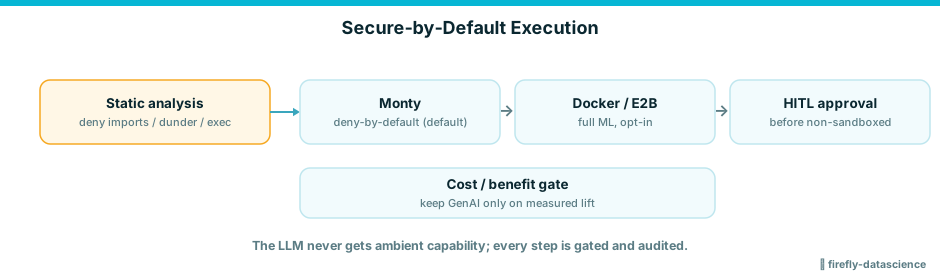
Threat model
The model is not trusted. We assume any of:
- A model emits code that exfiltrates data (
open,socket,requests) or escalates (os.system,subprocess). - The data itself carries a prompt injection — a column value or header crafted to make the model write malicious code.
- The model hallucinates code that corrupts the feature frame or hangs.
We do trust the host process, the installed libraries (pandas, numpy), and the configuration. The goal is: a wrong or hostile model snippet cannot do more than fail loudly.
The LLM proposes; the executor decides
The model only ever produces candidate text. It cannot import, open files, reach the network, or mutate your data. The classical executor — FeatureCodeExecutor — is the part that actually runs anything, and it does so under a static analysis pass, a minimal builtins allowlist, and a strict result contract. The proposal is cheap and untrusted; the decision to run is governed.
Layer 1 — static safety analysis
Before a single byte of model output executes, FeatureCodeExecutor runs it through the static analyzer reused from fireflyframework_agentic.execution. The policy denies dangerous modules, dangerous builtins, and all dunder access (which is how sandbox escapes are typically built):
from fireflyframework_agentic.execution import SafetyPolicy

policy = SafetyPolicy(
    denied_modules=frozenset(
        {"os", "sys", "subprocess", "shutil", "socket", "pathlib", "importlib", "builtins"}
    ),
    denied_builtins=frozenset(
        {"eval", "exec", "compile", "open", "__import__",
         "input", "globals", "locals", "vars", "getattr", "setattr"}
    ),
    deny_dunder_access=True,  # blocks ().__class__.__bases__... escapes
)
FeatureCodeExecutor constructs exactly this policy in its __init__, so you do not configure it by hand — but you should understand it. Analysis is AST-based and happens before execution:
from fireflyframework_datascience.features.executor import (
    FeatureCodeExecutor,
    FeatureExecutionError,
)

executor = FeatureCodeExecutor()

# Rejected statically — never runs:
try:
    executor.execute("import os; os.system('rm -rf /')", X)  # (1)!
except FeatureExecutionError as exc:
    print(exc)  # Unsafe feature code rejected: ...
osis indenied_modules, soanalyze_codereports the snippet as unsafe andexecuteraises before theexeccall is ever reached.
Internally the executor calls analyze_code(code, policy) and refuses to proceed unless report.safe is true, surfacing each report.violations[*].message in the raised FeatureExecutionError.
Expected
A rejected snippet raises a typedFeatureExecutionError (a subclass of FireflyDataScienceError) — it does not run, does not return a partial frame, and does not leak a stack trace from inside the model's code.
Layer 2 — restricted execution
Code that passes static analysis is still not trusted. It runs via exec with a minimal __builtins__ allowlist and a namespace that exposes only the dataframe and the two numeric libraries:
# Inside FeatureCodeExecutor.execute, conceptually:
namespace = {"df": X.copy(), "pd": pd, "np": np}  # (1)!
exec(compile(code, "<feature>", "exec"), {"__builtins__": _SAFE_BUILTINS}, namespace)  # (2)!
- The frame is a copy (
X.copy()) — model code mutatesdfin place, never the caller's original data. - The global
__builtins__is replaced by_SAFE_BUILTINS, so the usual escape hatches (__import__,open,eval) simply do not exist in scope.
_SAFE_BUILTINS is a hand-picked set — abs, min, max, sum, round, len, range, enumerate, zip, map, filter, sorted, the numeric/collection constructors (float, int, bool, str, list, dict, tuple, set), and pow. There is no open, no __import__, no I/O. Key properties:
- The frame is a copy (
X.copy()) — model code cannot mutate the caller's data in place. - The contract is pandas/numpy transforms only, never arbitrary capability. This is the CAAFE pattern.
- The result must be a
DataFrame, must add at least one new column, and every new column must be numeric and finite (inf/-infare replaced withNaN). Anything else raisesFeatureExecutionError.
# Valid CAAFE-style snippet — adds a numeric feature, mutates `df`:
code = "df['amount_per_day'] = df['amount'] / df['tenure_days'].clip(lower=1)"
X_enriched = executor.execute(code, X)
The post-conditions are enforced in order: a non-DataFrame result raises Feature code must leave a pandas DataFrame indf`; a frame with no new columns raisesFeature code added no new column; a non-numeric new column raisesNew feature . Every failure mode is a typedFeatureExecutionError`, so downstream estimators never receive a malformed frame.
Layer 3 — the tiered sandbox
Implementation status — what is enforced today
Layers 1–2 (static analysis + the restricted in-process namespace) are enforced.
execution.timeout_seconds is enforced (a wall-clock guard on the executor), and
require_approval is enforced when an approver is wired — fail-closed: code runs only if the
approver grants it. The container/microVM tiers (docker, e2b) are not yet implemented and now
fail fast rather than silently running in-process, so you can't mistake in-process for isolation.
The real isolation today remains the in-process monty / local path; for genuinely untrusted
data, wait for the container adapters (or supply your own CodeExecutorPort).
Layers 1 and 2 run in-process. They block the obvious capabilities, but a determined escape against a CPython process is never something to bet sensitive data on. execution.sandbox selects the tier; the in-process tiers run the restricted executor below, while docker / e2b raise until their adapters land:
from fireflyframework_datascience.core.config import FireflyDataScienceConfig

config = FireflyDataScienceConfig.load(profiles=["prod"])
config.execution.sandbox          # "monty" | "docker" | "e2b" | "local"
config.execution.timeout_seconds  # 60 by default
config.execution.require_approval # True by default — HITL gate
The tiers, from least to most isolated:
sandbox |
Isolation | Use for |
|---|---|---|
local |
In-process restricted executor (same code path as monty today) |
trusted data, dev only |
monty |
In-process restricted executor (default; == local today — a stricter interpreter tier is roadmap) |
typical CAAFE on owned data |
docker |
OS-level container, no host network/FS — not yet implemented, fails fast | untrusted data (roadmap) |
e2b |
Remote ephemeral microVM — not yet implemented, fails fast | untrusted data at higher assurance (roadmap) |
The literal type for sandbox is exactly Literal["monty", "docker", "e2b", "local"], defaulting to "monty" — any other value fails validation at load time. Set it via env or YAML — never hardcode local for production:
export FIREFLY_DATASCIENCE_EXECUTION__SANDBOX=docker  # (1)!
export FIREFLY_DATASCIENCE_EXECUTION__TIMEOUT_SECONDS=30
- The
FIREFLY_DATASCIENCE_prefix and the__nested delimiter come straight fromSettingsConfigDictonFireflyDataScienceConfig.EXECUTION__SANDBOXmaps ontoconfig.execution.sandbox.
Profile overlays outrank the base firefly-datascience.yaml, so a prod profile can tighten isolation without touching the base file. See Configuration for the full precedence order.
Beyond the strongest sandbox sits HITL (human-in-the-loop): execution.require_approval defaults to True, and the executor enforces it — when an approver is wired, generated code runs only if the approver grants it (and fail-closed if require_approval is set but no approver is available). A person, not a policy, signs off.
Defaults are the safe end of every axis
Out of the box, sandbox = "monty" (in-process restricted interpreter), timeout_seconds = 60, and require_approval = True. You loosen these deliberately. Note honestly: monty and local currently run the same restricted in-process executor — the difference is roadmap, not shipped — and the container/microVM tiers (docker/e2b) are not yet implemented and fail fast.
Prompt-injection-via-data defense
The subtle attack is not the model going rogue on its own; it is a column value or header that steers the model into writing malicious code. Firefly's answer is defense in depth that does not trust the model's intent:
- Static analysis is content-blind. It rejects
os,subprocess,socket, dunder access, andeval/exec/openregardless of why the model wrote them — so a successful injection still produces code that gets rejected. - The restricted namespace means even "clever" injected code has no I/O, no imports, no host reach.
- The numeric-new-column contract means injected code that tries to do anything other than add a numeric feature fails the post-conditions.
- HITL approval is enforced for untrusted data (require an approver to sign off, fail-closed). The container/microVM tiers (
docker/e2b) are not yet implemented and fail fast rather than running in-process — so points 1–3 plus approval are what protect you today.
The framework does not read your data's meaning
Firefly cannot inspect or sanitize the semantics of your data. Prompt-injection defense rests on capability restriction and sandboxing, not on detecting malicious text. Treat data of unknown provenance as untrusted input: raise execution.sandbox and keep require_approval on.
Governance — the CostBenefitGate
GenAI is off by default (genai.enabled = False) — Firefly is classical-first. When you do enable it, the CostBenefitGate is the governance control: it is a post-hoc, measured-lift filter — a proposal (feature or pipeline) is adopted only if it measurably beats the seeded baseline on cross-validation; anything that doesn't is discarded. (It governs what is kept, not token spend: genai.budget_usd is a declared ceiling whose pre-call enforcement is on the roadmap.)
config.genai.enabled            # False by default
config.genai.cost_benefit_gate  # True — gate LLM spend on expected benefit
config.genai.budget_usd         # declared ceiling (float | None); pre-call enforcement is roadmap
# firefly-datascience.yaml
genai:
  enabled: true
  default_model: "openai:gpt-4o"
  cost_benefit_gate: true
  budget_usd: 5.00
Two orthogonal gates: how much, and what
The CostBenefitGate is a governance control, not a security control: it governs what GenAI output is kept (only proposals that measurably beat the baseline), not capability. Keep both axes in mind — the gate governs whether a proposal earns its place; the executor and sandbox govern what its output may do. Neither substitutes for the other.
Limits of the trust model
Be precise about what these controls do and do not give you:
- In-process tiers (
local,monty) reduce but do not eliminate the risk of a CPython sandbox escape. For untrusted data usedocker/e2b. - Static analysis is an allowlist of capabilities, not a proof of harmlessness. Code can still be wrong, slow (mitigated by
timeout_seconds), or compute misleading features. - The framework does not sanitize your data's content — prompt-injection defense rests on capability restriction and sandboxing, not on detecting malicious text.
require_approvalis only as strong as the human approving. Do not rubber-stamp generated code.- Secrets in the host environment are visible to
local/montyexecution. Do not run untrusted-data jobs in a process holding production credentials.
Secure default, stated once
genai.enabled = False; when enabled, sandbox = "monty", require_approval = True, cost_benefit_gate = True. Relax deliberately, per profile, never globally.
See also
- Configuration —
ExecutionConfig,GenAIConfig, and the resolution precedence - LLM configuration — wiring a model once GenAI is enabled
- GenAI features — the CAAFE accelerator the executor protects
- Agentic loop — where generated code and the
CostBenefitGatemeet - Getting started — the classical-first default path