HTTP profile v2 reference
This reference explains the exact request and response policy that every Action
on the built-in weave-http@2.0.0 connector follows, and every check that
enforces it. Use it when you review an Action, design a connection, or read a
failure code. It is for integration developers, reviewers, and operators.
For a guided first result, follow Call a REST API without code instead: it builds an Action from command-line flags or an OpenAPI document and runs it on the local platform. This page does not create an API account or start an executor.
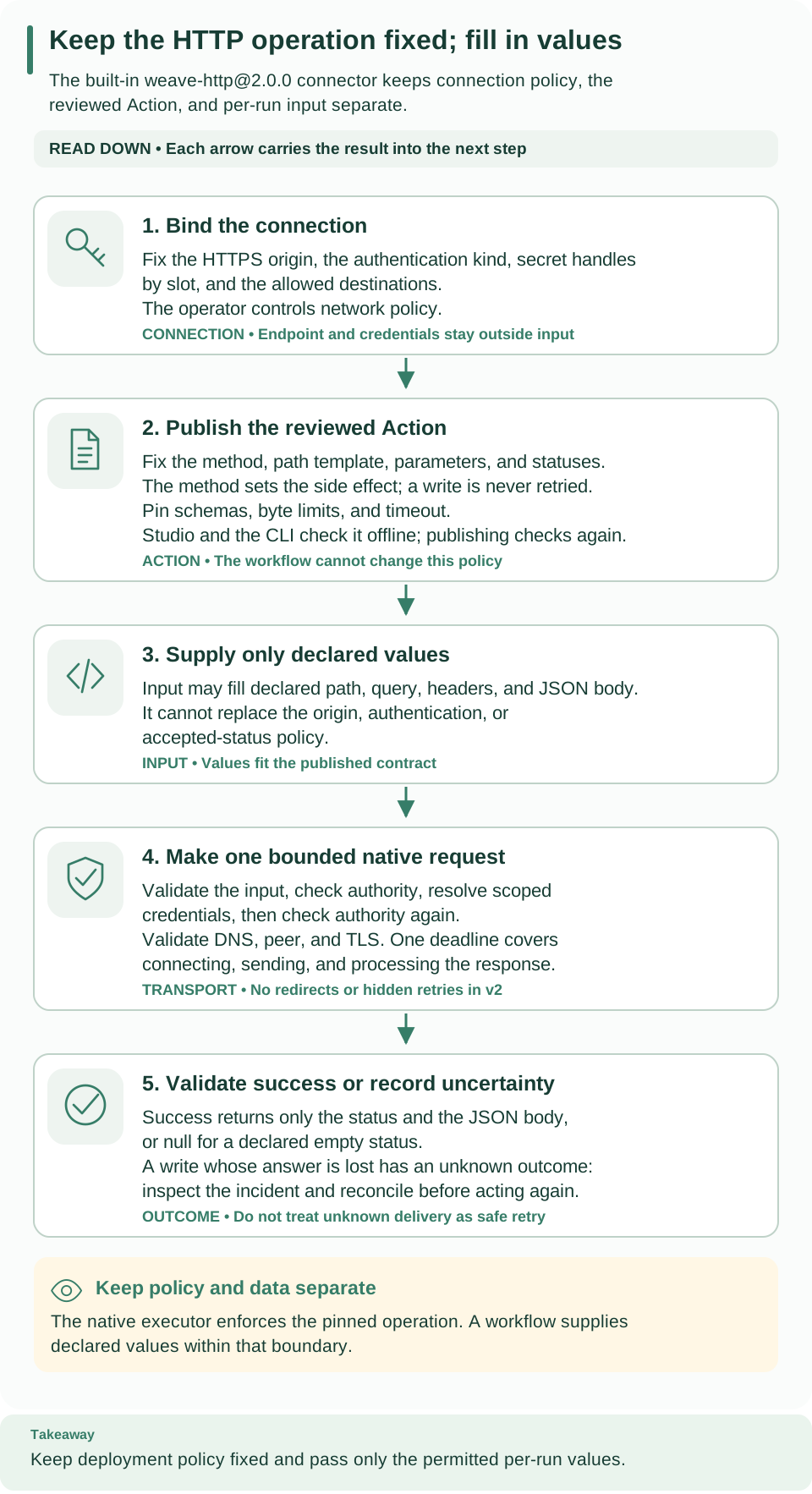
How to read this diagram: Read down from the connection and Action policy to invocation values, bounded execution, and outcome. Input fills declared fields; the connection and published Action retain control of origin, authentication, effect, and response policy.
How a profile call is put together
Three objects decide every call, and each one has a different owner:
| Object | Owner | What it fixes |
|---|---|---|
| Integration connection | A person with connection.manage, per environment |
The HTTPS or HTTP origin (baseUrl), the authentication kind, the secret handles, and the allowed destinations |
| Action | The author, published once | The method, the path template, declared parameters, the side effect, accepted and empty statuses, schemas, and timeout |
| Invocation input | The workflow, on each run | Only values for the declared path, query, and header parameters, and the JSON body |
Before a real call, the environment also needs the published connector, an
executor release, and its grants. On the
local platform, weave platform integrations
enable prepares them; elsewhere, follow the
operator steps and the
publication and worker sequence.
weave connector http-action and weave connector import-openapi --target builtin
produce Actions for you, and weave connections create --api-url builds the
connection with its allowed destinations. For a first offline example of the
package target, run the OpenAPI importer.
It generates a GET Action for /v1/items/{id}. Its invocation input is
{"path":{"id":"item-123"}}; a successful illustrative output is
{"status":200,"body":{"name":"Widget"}}. The generated response schema requires
name; an arbitrary successful JSON response is not enough.
These are the complete connection request and operation object for the same
anonymous profile. The operation object belongs under the Action's
spec.implementation.config:
{
  "name": "inventory",
  "connector_version_id": "00000000-0000-4000-8000-000000000001",
  "config": {"baseUrl": "https://inventory.example.test", "auth": {"kind": "none"}},
  "secretRef": {},
  "allowed_destinations": ["https://inventory.example.test"]
}
{
  "profileVersion": "2.0.0",
  "method": "GET",
  "path": "/v1/items/{id}",
  "sideEffect": "read_only",
  "parameters": [{"name": "id", "location": "path", "type": "string", "required": true}],
  "statuses": [200],
  "emptyStatuses": []
}
Replace the UUID with the published Connector version ID. The .test origin is
an offline example, not a deployed service. For an imported package, copy its
exact generated connection config and Action rather than changing these objects
independently of their immutable schemas.
Profile rules
Identity and versions
weave-http@2.0.0 uses adapter identity weave-http-v2 and task and
implementation version 2.0.0. The original weave-http@1.0.0 descriptor,
adapter, and active pins keep their behavior. The v2 identity is additive because
the registry binds one descriptor to one adapter identity. Generated custom
packages use the same native v2 executor with exact operation-specific schemas
and capabilities.
The Action configuration fixes profileVersion: "2.0.0", the method, a path
template that starts with / and is appended to the connection's origin, the
effect, declared parameters, success statuses, and empty-body statuses. Each operation's full configuration is part of its immutable pin. An
Action input cannot change the origin, authentication, template, headers, or
status policy.
Connection and authentication
The connection configuration contains a fixed https:// or http:// origin in
baseUrl and an auth profile. Each authentication kind needs exactly these
secret slots in secretRef; missing or surplus slots fail:
| Auth kind | Nonsecret profile | Exact secretRef slots |
|---|---|---|
none |
kind only | none |
api-key |
kind and header name | api_key |
basic |
kind | username, password |
bearer |
kind | token |
machine-token |
kind, client_id, endpoint, scopes, authentication |
client_secret |
- Machine tokens. Client authentication is
client_secret_postorclient_secret_basic. The endpoint and the exact scope set are immutable; the shared PyFly-backed machine service owns OAuth parsing, bounds, and cleanup. Tokens are opaque, single-use, and never cached across invocations. There is no separate audience or resource parameter, and no interactive or refresh-token implementation. - Secret values. A basic user name cannot contain a colon. Every secret header value is bounded and cannot contain control characters. Credential values never belong in config, Action input or output, or logs.
- Plain HTTP. An
http://origin is accepted exactly as onweave-http@1.0.0, with or without credentials, and is not encrypted: secret headers and bodies travel in plain text. Every such connection is flagged: the connection test answers"encrypted": false, the CLI printsNot encrypted: requests to http://… travel in plain text.on standard error, and Studio shows a "Not encrypted" notice next to the API address. Machine-token endpoints stay HTTPS-only.
Request shaping
Every call validates input and configuration, checks current authority, resolves only the selected slots, and checks authority again immediately before dispatch.
- Paths. Each substituted segment is encoded once, so slash, percent, query,
and fragment delimiters cannot replace the origin. Empty,
., and..path values fail. - Query arrays. Sent as repeated encoded keys.
- Headers. Protected, authentication, and transport headers cannot be Action parameters.
- Size. Request byte accounting includes the URL, headers, and body. Normal JSON Schema validation remains authoritative alongside the transport budgets.
Network and transport
- The existing pinned-DNS, pre-write peer, destination, and TLS policies apply.
Connections use
https://orhttp://; a public address needs no private-origin entry. Private, loopback and CGNAT destinations require an entry of the private-origin policy (weave platform up --allow-private-origin) or an operator-approved range in the legacyWEAVE_HTTP_PRIVATE_NETWORKS(see Configuration); link-local, metadata (including100.100.100.200), and Kubernetes service destinations are always refused. Ambient proxies are disabled. - All v2 redirects are rejected, including read redirects; no credential is forwarded to a redirect.
- There are no hidden retries. Acquisition, I/O, and response processing share the Action deadline; cancellation reaches the existing worker settlement.
- A non-idempotent call whose acknowledgment is lost, invalid, oversized, or
sensitive returns an
unknownoutcome after dispatch.
Outputs
Outputs contain only the status and the validated JSON body, or null for a
declared empty response. Response headers and raw error bodies are not returned.
Credential and token echoes in keys or nested values are withheld. The shared
diagnostic guard contains owned HTTP-library records; operators still control
reverse proxies and arbitrary instrumentation.
Connection tests
test_connection checks the configuration and slot policy without acquiring
credentials or sending requests. Its ok means that the local configuration
passed, not that a provider authenticated or a destination is reachable.
weave connections test ID runs it for a saved revision; its request file is
optional. Installed connector test --mode native likewise tests composition,
not a remote account. For a connection whose baseUrl is http://, the answer
also carries "encrypted": false (true for https://; absent for connectors
without an HTTP base URL), and the CLI prints the "Not encrypted" line on
standard error.
Checks before a run
These checks are new in 0.1.0a7. An alpha6 or earlier CLI or platform does not run them.
The same rules are checked at three points, so a mistake surfaces before a run reaches the executor.
While you build
weave connector http-action and the importer's built-in target check each Action
offline against the descriptor bundled with the CLI, and compile it against a
catalog holding only that descriptor. Problems are WV-HTTP-ACTION-* diagnostics
with a pointer into the request:
- errors such as
PATHfor an invalid template,PARAMETER,PROTECTED_HEADER,BODYfor a body onGETorHEAD, andSTATUSfor an empty status that is not also a declared status; - informational notes such as
PATH_PARAMETER_ADDED(an undeclared placeholder became a required string) andUNTYPED_RESPONSE; - the warning
SAMPLE_TRUNCATEDwhen a sample exceeded the inference budget; WV-HTTP-ACTION-IOfor a file that is missing, malformed, or already exists.
weave connector descriptor weave-http-v2 prints the installed descriptor from
the selected platform, or the copy bundled with the CLI ("provenance":
"local-copy") when no platform is selected or with --local. Always publish the
manifest the platform reports.
When you publish
The platform runs the descriptor's Action checks during definitions.publish and
when it compiles or validates with its catalog. A violation fails publication
with WV-COMPILE and one of these diagnostics, each pointing into the Action
document:
| Code | Rule |
|---|---|
WV-COMP-CONFIG_CONTRACT |
The config fits the profile field by field; read sends only GET or HEAD; write uses non_idempotent; path placeholders and required path parameters match both ways; protected headers and status rules hold |
WV-COMP-SIDE_EFFECT_CONTRACT |
spec.sideEffect equals the config's side effect |
WV-COMP-INPUT_CONTRACT |
Input groups are only path, query, headers, and body, declare and require every required parameter with a compatible type, name no undeclared parameter, and have no body on GET or HEAD |
WV-COMP-OUTPUT_CONTRACT |
Every accepted status passes properties.status, empty statuses accept a null body, and only status and body are required |
The checks apply to the Action being compiled, not to Actions a workflow merely
depends on. Schemas that use local $ref pointers are left to runtime
validation. Offline weave workflow compilation does not run these checks.
When you create a connection
The guided weave connections create flags check the request locally before any
network call; a rejection exits 2 with WV-CONNECTION-INPUT and
WV-HTTP-CONNECTION-* diagnostics.
The platform rejects a connection with HTTP 422 WV-CONNECTION and a
diagnostics array. Its codes are WV-CONNECTION-CONNECTOR, -CONFIG, -AUTH,
-SECRET, or -DESTINATION, with pointers such as /connector_version_id,
/config/baseUrl, /secretRef/<slot>, or /allowed_destinations/<index>. An
unavailable handle always reads "This secret handle is not available in this
environment." and never names other handles.
connections.create accepts an optional Idempotency-Key: the same key and body
replay the original revision, and the same key with another body returns 409.
Failure codes
A task that fails at run time reports one of these codes and an outcome. Before
the request is sent the outcome is not_started. After it is sent, a read that
fails is failed, and a write is unknown: it may have taken effect.
| Code | Cause |
|---|---|
HTTP_PROFILE_CONFIG |
The operation or connection configuration is outside the profile, or the action and side effect disagree; always not_started |
HTTP_PROFILE_AUTH |
The secret slots differ from the authentication kind, or a credential value is empty, too long, or has invalid characters |
HTTP_PROFILE_INPUT |
The run input fails the Action's input schema or the parameter rules, the resulting URL exceeds 16 KiB, or another check fails before the request is sent, such as current authority or a credential grant |
HTTP_PROFILE_LIMIT |
The headers, the whole request, or the response exceed their byte limits, or the response used an unsupported content encoding |
HTTP_PROFILE_TIMEOUT |
The Action deadline passed |
HTTP_PROFILE_UNAVAILABLE |
The connection to the destination could not be opened; always not_started |
HTTP_PROFILE_DESTINATION |
The destination is not allowed or resolves to a refused address |
HTTP_PROFILE_STATUS |
The status is not one of the Action's accepted statuses, including every redirect |
HTTP_PROFILE_OUTPUT |
The body is not JSON, an empty status carried a body, or the result fails the output schema |
HTTP_PROFILE_SENSITIVE |
The response echoed a credential, so it was withheld |
HTTP_PROFILE_FAILED |
Another failure after the request was sent |
If admission fails, compare the auth kind, the secret slot names, and the allowed
origins first. If a run is queued, check native executor release admission and
capacity. If a call fails after dispatch, inspect the run incident's outcome: an
unknown write may already have happened.
Incident operations explains
reconciliation and permitted retry.
Verification
V2 serialization, auth-slot and authority boundaries, response and outcome rules,
and generated native package TLS execution are covered by local contract and TLS
integration tests, and plain-HTTP reach by an integration test against the
in-process Acme fixture. On the local platform, the real-platform browser suite
builds a GET /orders/{id}/status Action with Studio's New API action
builder and runs it to succeeded against the local Acme fixture at
http://acme.acceptance.test:8080, the origin approved with weave platform up
--allow-private-origin, so no internet API is involved; see
Call a REST API without code. No commercial API account
was contacted and no live compatibility with any provider is claimed.
Next steps
- Build and run a first Action: Call a REST API without code.
- Generate a named connector package from OpenAPI instead: OpenAPI connector import.
- Write custom code when the profile is not enough: Author a trusted connector package.