Receive messaging events with provider sources
A provider source is an immutable route from one authenticated messaging installation (Microsoft Teams, WhatsApp, or Telegram) to one workflow activation or one waiting signal. When the provider calls Weave, Weave checks the provider's own authentication, stores each event as a receipt, and acknowledges. A background dispatcher then starts the run or sends the signal.
Who it is for. Integration developers and operators who connect a messaging
channel to workflows. For your own system, a signed webhook
is simpler. What you need. A platform that can run the provider's connector
package: a deployment, or the manual local installation
with a native executor. The local platform from
weave platform runs only the built-in HTTP connector, so it cannot run
messaging connectors. You also need the provider's installation guide (Teams,
WhatsApp, or Telegram);
and, for a workflow that replies, native worker admission
and connector publication and activation.
Allow about 30 minutes after the provider side is ready.
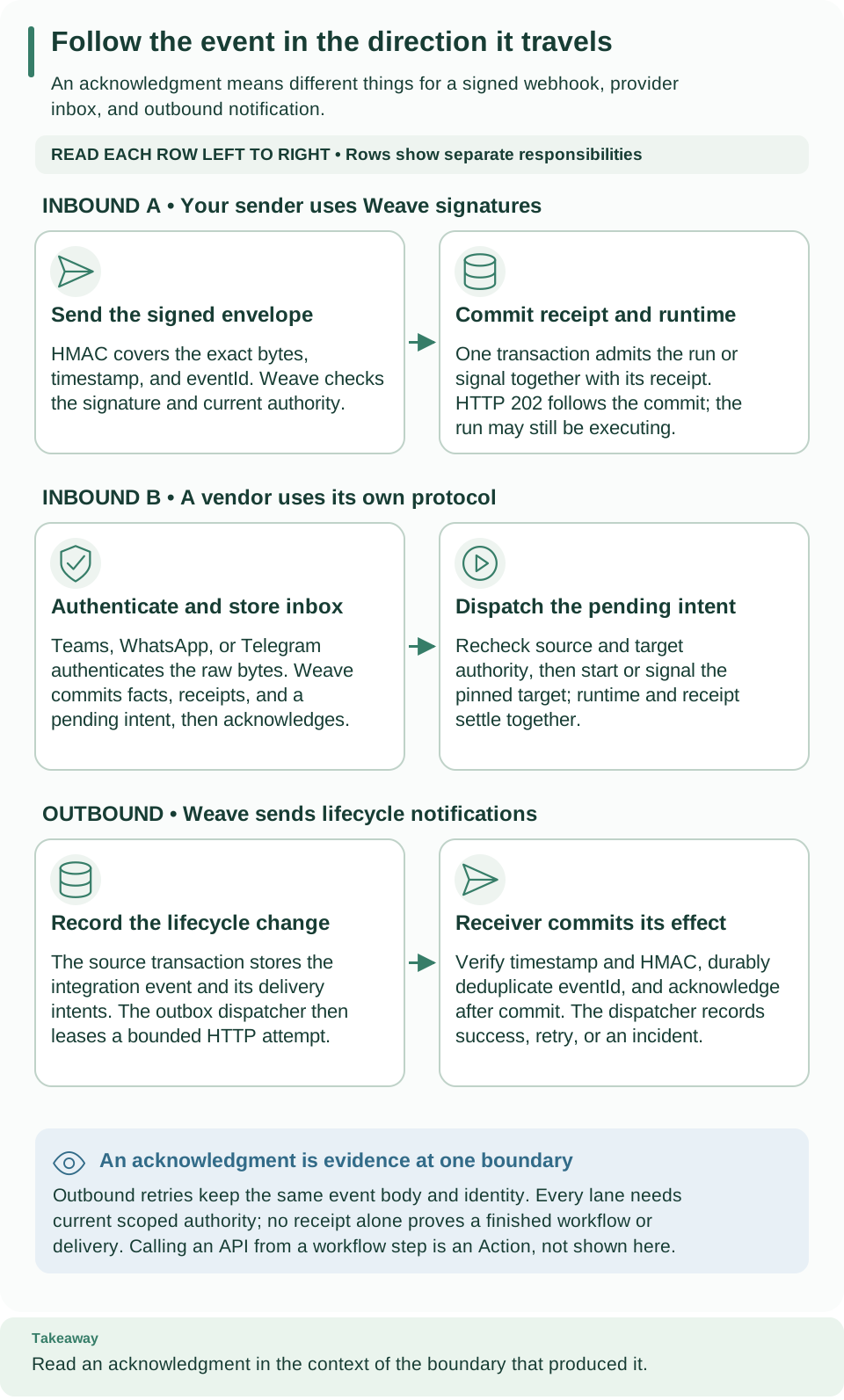
Follow the middle row. The provider's acknowledgment comes right after the inbox
commit; a later transaction starts or signals the pinned target. After a receipt
shows dispatched, read the linked run to see what actually executed.
Open diagram at full size
The acknowledgment is not completion. A successful response to the provider promises that the event is stored durably, not that the workflow ran or that any reply was delivered.
Create one inbound route
Run the commands with a saved platform and workspace from weave auth setup
(see how remote commands choose a platform).
Saved platforms are new in 0.1.0a7; with an alpha6 or earlier CLI, these
commands use explicit mode.
Collect these values first:
| Value | Where it comes from |
|---|---|
| A person with the right grants | trigger.manage and connection.bind (deployer), connection.manage (tenant_admin), run.start or run.signal for the target (operator), and run.read to inspect receipts (viewer) |
connection_revision_id |
The id returned when you create the integration connection |
activation_id |
The id returned when you activate a compatible workflow |
| Package, version, and schema pins | The exact provider declaration installed on the server, never a version copied from an example |
policy |
The integration connection's complete provider config |
-
Create the integration connection. Save the complete connection request from your provider's guide as
connection.json, then:# Create the provider connection; its secret handles were granted by the operator. weave connections create --request connection.json --output jsonExpected: a connection revision whose
idyou save asCONNECTION_REVISION_ID. -
Activate the workflow that receives the events, and save the activation's
idasACTIVATION_ID. -
Generate the source request. The pins must match the provider declaration the server has installed, so run this with a Python environment that has the same Weave version as the server installed (
pythonbelow must importfirefly_weave). It reads the declaration and sends nothing. This example is for Telegram:# Record the two IDs, then generate source.json from the installed declaration. export CONNECTION_REVISION_ID='replace-with-returned-connection-uuid' export ACTIVATION_ID='replace-with-returned-activation-uuid' python - <<'PY_SOURCE' > source.json import json import os from pathlib import Path from uuid import UUID from firefly_weave.connectors.telegram import package from firefly_weave.contracts.providers import ProviderSourceRequest, provider_schema_digest metadata = package.metadata.model request = ProviderSourceRequest( name="telegram-text", provider="telegram", package=metadata.distribution, package_version=metadata.distribution_version or metadata.version, adapter_version=metadata.version, schema_digest=provider_schema_digest(metadata.event_schemas, metadata.dispatch_event_kinds), connection_revision_id=UUID(os.environ["CONNECTION_REVISION_ID"]), policy=json.loads(Path("connection.json").read_text())["config"], kind="run", activation_id=UUID(os.environ["ACTIVATION_ID"]), mapping={"ref": "/payload"}, ) print(request.model_dump_json(exclude_none=True, indent=2)) PY_SOURCEExpected:
source.jsonwithname,provider,package,package_version,adapter_version,schema_digest,connection_revision_id,policy,kind,activation_id, andmapping. For another provider, change the imported declaration,name, andprovider, and use that provider's connection file and a target whose input schema accepts its events. -
Create the source:
# Create the immutable route; the server assigns its ID, scope, and owner.
weave provider-sources create --request source.json --output json
Expected: your request plus
id,scope,binding_id,principal_id, and"disabled": false. SaveidasSOURCE_ID. -
Point the provider at Weave. Configure the provider's callback to
https://YOUR_PUBLIC_WEAVE_HOST/provider-ingress/SOURCE_ID. This route is outside/api/v1and uses the provider's authentication, never your CLI bearer token. The random route ID grants no authority on its own. -
Send a test event from the provider, then inspect it as described in the next section.
For a signal target, use "kind": "signal", leave out activation_id, and
supply the existing run_id and the declared signal name.
Inspect admission separately from execution
After an authorized test delivery, find the receipt whose source_id and
event_id match, then read its run:
# List receipts in this environment; pass --cursor with next_cursor for the next page.
weave provider-receipts list --limit 20 --output json
# Read one receipt by ID to see its status, reason, and resulting run_id.
weave provider-receipts read RECEIPT_UUID --output json
Expected: a receipt with status and, once dispatched, the resulting run_id
(and signal_id for a signal target). Read that run with
weave runs read RUN_ID --output json.
| What you see | What to check next |
|---|---|
| No receipt, HTTP 401 | The provider signature, secret, and installation policy; the route UUID is not a credential |
| No receipt, HTTP 422 or 413 | A payload or schema rejection, or a size or batch limit; no part of that batch was stored |
pending |
A scheduler-enabled dispatcher, database readiness, platform capacity, and the retry cooldown |
ignored |
The safe reason; lifecycle and unsupported events may intentionally start nothing |
blocked |
The source owner's current grants, the standing binding, and package availability |
failed |
The target run or activation and its schema; read the reason before an explicit retry |
dispatched |
Read the linked run; it may still be waiting, suspended, or failed |
To try a blocked or failed receipt again:
# Retry the same event; its identity is preserved and authority is checked again.
weave provider-receipts retry RECEIPT_UUID --output json
A retry cannot re-enable a disabled source or make a finished signal target writable. A replacement source has its own deduplication scope.
How an event flows
- The provider sends exact raw bytes and its protocol headers to the native verifier.
- The verifier authenticates them, checks the installation, and normalizes up to 100 typed events.
- One transaction locks the source, classifies the whole batch, runs the provider's admission hook for new events only, and stores receipts and dispatch intents.
- The provider receives its acknowledgment after that commit.
- The background dispatcher locks the source and a pending receipt, and rechecks authority.
- It starts the exact activation or signals the exact run.
- The runtime state and the receipt settle in one transaction.
Provider sources use installed, operator-allowlisted native verifiers. Each of Teams, WhatsApp, and Telegram implements its own authentication and installation policy; enable the package explicitly.
What a source pins
- The provider declaration. Package distribution, its exact installed version,
a concrete adapter implementation version, the provider, and the SHA-256 digest
of its effective event-schema and dispatch-kind contract.
distribution_versionis an exact installed identity (for example0.1.0a1), withversionas the fallback for stable packages;versionis the adapter implementation SemVer. A request may omitadapter_versiononly when one declaration matches; the server always stores a concrete version. Two providers or adapters in one distribution keep distinct verifier identities. Built-in providers use a trusted native declaration path, and third-party declarations cannot claim reserved built-in adapter names. - The connection. The exact connection revision and installation policy.
policyentries must be exact copies of the connection's validated config keys; a key absent from the connection cannot appear asnull. When the connection definesaccount_id, the source must pin that nonempty string. - The target. Either an exact activation, or an exact run plus signal name.
- The mapping.
mappingis a workflow expression; the default{"ref": "/payload"}passes the normalized payload.
The server assigns the scope, owner, ID, and standing connection binding. To change anything, create a new source; disabling a source is irreversible for that ID.
Checks at creation and dispatch. Static schema containment is checked when the
source is created, for every dispatchable event kind. Every dispatch payload is
validated and classified for secrets before admission. Other required provider
identity fields are checked before any write by the optional
ProviderSourceValidator.validate_source(request, connection) port, which
receives copies and performs no I/O. There is no external schema retrieval,
arbitrary run search, implicit fan-out, sender-to-person mapping, or automatic
attachment download.
Routes and permissions
Management routes are under
/api/v1/tenants/{tenant}/projects/{project}/environments/{environment}:
| Resource | Methods | Required current authority |
|---|---|---|
/provider-sources |
POST, GET | Create: trigger.manage, standing connection.manage and connection.bind, and target run.start or run.signal; list: run.read |
/provider-sources/{identifier} |
GET | run.read |
/provider-sources/{identifier}/disable |
POST | trigger.manage, connection.bind, and the target capability |
/provider-receipts |
GET | run.read |
/provider-receipts/{identifier} |
GET | run.read |
/provider-receipts/{identifier}/retry |
POST | run.retry, the target capability, and the current source owner, binding, package, and target authority |
Lists take limit (1 to 100) and an opaque, scope-bound cursor, and return
next_cursor. Receipt views show identities, times, attempts, safe reason codes,
and the resulting run and signal IDs, never the stored normalized or mapped
payload. Read authority cannot authorize a retry.
Public ingress and duplicates
POST /provider-ingress/{identifier} receives events; provider-specific
challenges use GET on the same route. The private lookup returns only scope
coordinates, never credentials or source policy. Authentication sees the exact
bytes before parsing. Controllers read at most 1 MiB and reject duplicate
headers; normalization allows at most 100 events. A challenge checks its own
protocol credential and never stores a receipt or starts a run.
An event's identity is (source ID, event kind, provider event ID). Its
fingerprint covers typed facts, disposition, and occurrence time, but not the
receive time or retry metadata. An exact replay reuses the stored event and never
repeats the admission hook.
| Response | Meaning |
|---|---|
| Provider acknowledgment | Durable admission only, not workflow completion or delivery |
| 401 | Authentication failed (safe response) |
409 WV-PROVIDER-CONFLICT |
An identity conflicts with a stored event; the whole batch is rejected, including its new events |
| 413 | The body or batch is too large |
422 WV-PROVIDER-PAYLOAD |
A schema or secret rejection |
| 500 | An unexpected failure before commit; nothing is acknowledged |
Receipts, dispatch, and retries
Receipts are pending, dispatched, ignored, blocked, or failed.
- Ignored events. Verified lifecycle or unsupported events need an explicit
ignoredisposition and a safe reason. - Finished targets. A finished run keeps its pinned schema for admission:
lifecycle hooks can still record removal, while new dispatch events become
visible
failedreceipts without changing that run. - Credentials and hooks. Native verifiers can use
ProviderCredentialsto resolve scoped secret handles through the bounded connection resolver, which checks source, owner, and binding authority before and after access. A verifier may implementProviderAdmissionHook.persist(tx, source, events)for its own protocol state; it receives only new events, no raw authentication bytes, and performs no network or runtime work. If the hook fails, its state, the receipts, and the intents roll back together.
The dispatcher. An independent background loop, owned by the API process
when scheduler_enabled is on, keeps durable tenant and environment cursors. Per
environment turn, it processes at most ten due receipts, with a five-second total
deadline per dispatch, a four-second SQL limit, and a one-second lock limit.
Transient failures roll back and wait a stored thirty-second cooldown; the
receipt stays pending with the reason transient_failure. A capacity refusal
(WV-OPERATION-CAPACITY or WV-REQUEST-CAPACITY) is a transient failure. Missing
authority produces blocked; a finished target or schema failure produces
failed. Both need an explicit retry, which keeps the event's identity. API-only
replicas can leave pending work for a dispatcher replica.
Locks and isolation. Locks are taken in this order: source FOR UPDATE,
receipt FOR UPDATE, standing binding FOR SHARE, the existing runtime locks,
then the outbox project advisory lock. Admission takes the source lock and checks
every duplicate before hooks and inserts. Revoking a binding touches only that
binding; outbox subscriptions use separate outbox-subscription bindings.
Provider tables force tenant, project, and environment row-level security, and
each transaction sets all three scope values. No scope survives a transaction.
Event kinds and the schema digest
A package may declare dispatch_event_kinds, a nonempty, unique subset of its
event_schemas keys; when omitted, every declared kind can dispatch. Other kinds
may only return disposition="ignore", and their own schema and secret checks
still apply. firefly_weave.contracts.providers.provider_schema_digest(event_schemas, dispatch_event_kinds)
computes the pin as the canonical SHA-256 JSON digest of
{"event_schemas": event_schemas, "dispatch_event_kinds": sorted(effective_kinds)}.
Reordering a declaration keeps the pin; changing which kinds can dispatch changes
it. There is no dynamic event filter language.
CLI, SDK, and storage
The CLI families are weave provider-sources (create, list, read,
disable) and weave provider-receipts (list, read, retry). They print
safe JSON. Exit 1 means remote validation or authorization failure, 2 a
local configuration problem, and 3 a server failure; nothing is replayed
automatically. The SDK methods are create_provider_source,
read_provider_source, list_provider_sources, disable_provider_source,
read_provider_receipt, list_provider_receipts, and retry_provider_receipt.
Native OpenAPI and the exported schemas include every provider DTO and operation.
Migration 0018_provider_inbox follows 0017_outbox. Retention and restore must
keep provider_sources, provider_receipts, provider_intents, connection
source bindings, and provider protocol tables together. Pending receipts and
their runtime effects settle atomically, so a restart can retry without creating
another run. Follow the retention and
backup and restore procedures to keep these
relationships intact.
Next steps
- Finish your provider's setup: Teams, WhatsApp, or Telegram.
- Call HTTP APIs and accept signed webhooks: the simpler route for your own systems.
- Incident operations: what to do when a dispatched run is suspended.
Troubleshooting
| What you see | Why | What to do |
|---|---|---|
provider-sources create is rejected for policy |
policy differs from the connection's config |
Copy the connection's config exactly, including list order |
| Creation is rejected for the schema digest or version | The pins come from a different Weave version than the server's | Regenerate source.json with the server's Weave version |
| The provider reports 401 | Provider authentication or installation policy failed | Check the provider secret handles and installation settings in its guide |
Receipts stay pending |
No scheduler-enabled replica is running, the database is not ready, or the platform refused dispatch for capacity (reason transient_failure) |
Start a replica with the scheduler enabled; check readiness. A capacity refusal is retried after the cooldown |
A receipt is blocked |
The source owner lost a grant, or the binding was revoked | Restore the grant, then weave provider-receipts retry RECEIPT_UUID |
A receipt is failed |
The target run finished, or the payload does not fit the target's schema | Read the reason; fix the target, then retry or create a new source |