Notify your application about workflow events
Weave can tell your application when something changes: a run moves to a new status, a definition is published, or an activation is activated or retired. A subscription selects which of these future events to send and to which fixed HTTP destination. A delivery is the durable record of sending one event to one subscription revision, with every attempt.
Who it is for. Integration developers who build the receiving endpoint, and operators who keep deliveries healthy. This page covers outbound notifications only; to bring business events into Weave, use signed webhooks or provider sources. What you need. A platform from the standalone setup or the local platform, a receiving HTTPS endpoint you control, and an operator who can grant a signing secret handle. Allow about 30 minutes.
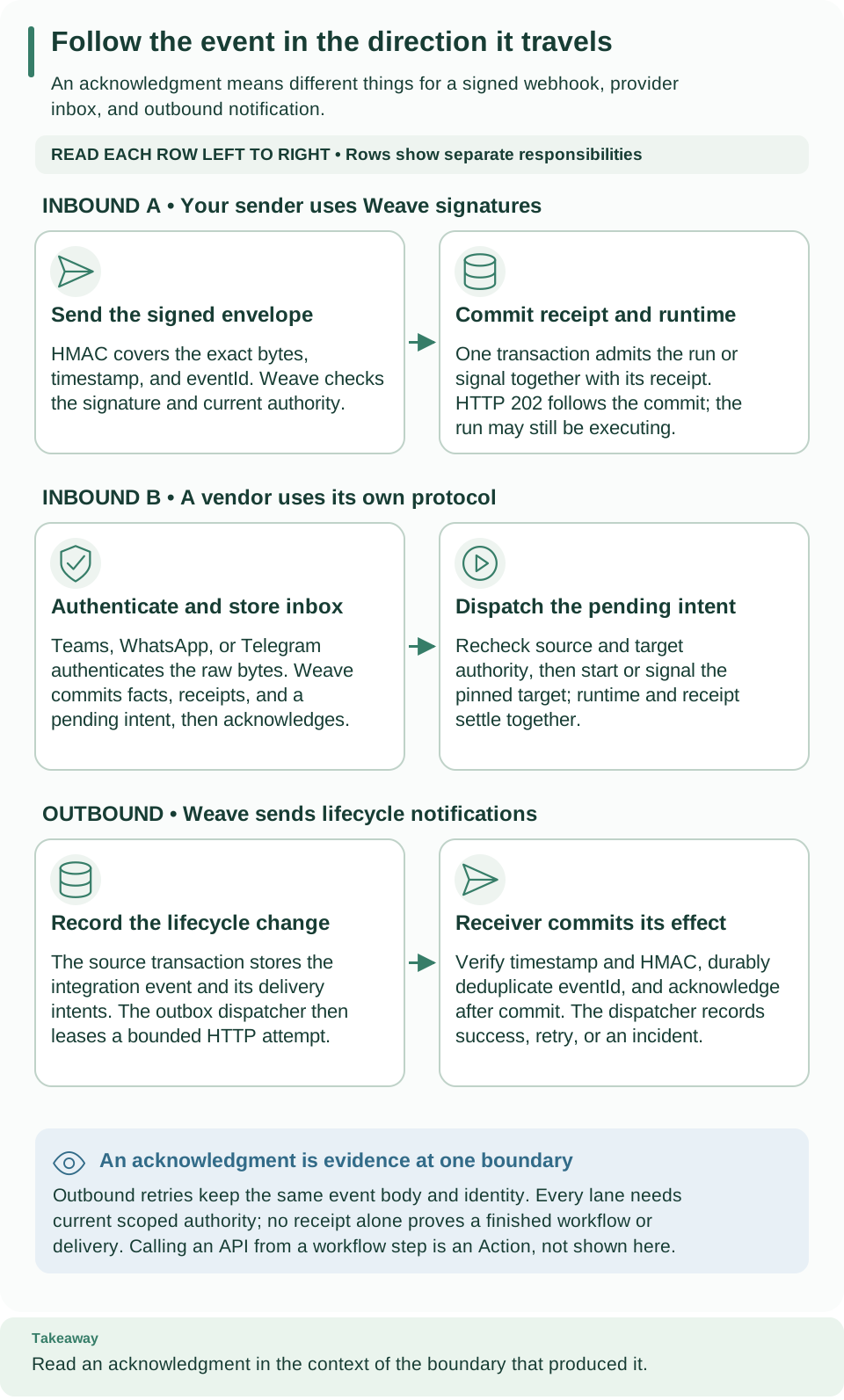
Follow the bottom row from the recorded change to the receiver's committed effect and acknowledgment. The change and its delivery intent are stored in the same transaction; the outbox dispatcher then sends a bounded attempt. The upper rows are inbound routes with different acknowledgment rules. Open diagram at full size
What Weave sends
Events are delivered at least once. Each notification carries controlled identity, status, sequence, revision, and emission metadata, and never business input or output, source documents, free-form errors, your correlation strings, or workflow evidence.
| Event type | Sent when | Scope |
|---|---|---|
run.transition |
A run's accepted status changes | The run's environment |
definition.published |
A definition version is published | The project; the environment is null |
activation.activated |
A version is activated in an environment | That environment |
activation.retired |
An activation is retired | That environment |
The event's correlation_id is the stable UUID of the source resource. The
change, the immutable event, and every matching delivery intent commit in the
same transaction, so a failed append rolls back the change itself. Replaying a
change keeps its event ID. New subscriptions never receive historical events.
Set up a subscription
Run the commands with a saved platform and workspace from weave auth setup
(see how remote commands choose a platform).
Saved platforms are new in 0.1.0a7; with an alpha6 or earlier CLI, these
commands use explicit mode.
-
Build the receiver first. It must verify the signature and timestamp, store
eventIddurably to discard duplicates, commit its own effect, and only then return a configured success status. See Receive and acknowledge.examples/idempotent_receiver.pyshows a durable effect ledger for a different request shape; it does not implement this envelope or its HMAC, so it is not a drop-in receiver. -
Get a signing secret handle. The operator grants a handle, such as
release-receiver-key, to your environment inWEAVE_SECRET_GRANTS. Its value must be at least 16 bytes of high-entropy, destination-specific data that uses only the bearer-token alphabet[A-Za-z0-9._~+/-](with optional trailing=). The same value authenticates the bearer request and the HMAC signature, so give your receiver the same value. -
Create an integration connection on
weave-http@1.0.0. Subscriptions send through the original HTTP connector, not the no-codeweave-http@2.0.0. Ifweave-http@1.0.0is not yet published in your project, see the original HTTP connector. Save this asreceiver-connection.json, using the connector version ID of the publishedweave-http@1.0.0and your receiver's origin. Since 0.1.0a7,weave connector descriptor weave-http --output jsonshows that ID aspublished_version_id:{ "name": "release-receiver", "connector_version_id": "00000000-0000-4000-8000-000000000009", "config": {"baseUrl": "https://receiver.example.com", "auth": "bearer"}, "secretRef": {"token": "release-receiver-key"}, "allowed_destinations": ["https://receiver.example.com"] }# Create the bearer connection; the request names the handle, never the value. weave connections create --request receiver-connection.json --output jsonExpected: a connection revision. Save its
idas the connection revision ID. A private destination also needs the operator's private-network policy. -
Create the subscription. Save this as
subscription.json, replacing the connection UUID:{ "name": "release-notifications", "connection_revision_id": "00000000-0000-4000-8000-000000000001", "signing_slot": "token", "path": "/weave/events", "event_types": ["definition.published", "activation.activated", "activation.retired"], "statuses": [200, 202, 204] }# Save the subscription; saving the same name later creates a new revision. weave subscriptions save --request subscription.json --output jsonExpected: your request plus
id,revision,binding_id,principal_id, and"active": true. Saveid,revision, andbinding_id. -
Keep a dispatcher running. A scheduler-enabled replica runs the outbox dispatcher. A native action worker does not send these notifications.
-
Cause one matching event, such as publishing a definition, then inspect the delivery:
# List deliveries and find the one whose subscription_id matches yours.
weave deliveries list --output json
# Show every attempt for that delivery, with timing and outcome codes.
weave deliveries history DELIVERY_ID --output json
Expected: a delivery with status
deliveredonce your receiver returned a configured success status. Confirm the business effect in the receiver's own store as a separate check.
Configure a destination
The connection must be an admitted, immutable weave-http (v1) revision with a
reviewed origin, explicit allowed destinations, and an operator-approved
credential handle. The v1 contract provides one token slot with auth: bearer,
so signing_slot is token.
Who may configure. The configuring person needs subscription.manage,
connection.manage, connection.bind on that exact connection, and read
authority for the events: run.read for run events, catalog.read for catalog
events. Publication events need project-wide catalog authority; an
environment-only grant cannot export project metadata. Administration alone
grants no business read permission. A request cannot choose its principal or
carry secret bytes.
| Role | Can |
|---|---|
deployer |
Manage subscriptions (subscription.manage) |
operator |
Read deliveries (delivery.read) and retry them (delivery.retry) |
viewer |
Read deliveries (delivery.read) |
Revisions. Saving the same name creates a new immutable revision pinned to the person who saved it. Only future events match the new revision; existing deliveries keep their original connection, path, event types, owner, signing handle, and statuses. Old revisions stay readable.
Stopping deliveries. Disabling a revision (weave subscriptions disable)
stops new matches. Revoking its connection source binding (weave source-bindings
revoke) also stops pending deliveries. A project can have at most 64 active
subscriptions; one more is rejected rather than silently dropping fan-out.
Key rotation. The value behind the handle may rotate. Each attempt resolves the current bytes and records the provider's opaque version when there is one; no value or digest is stored. Coordinate rotation with the receiver. The environment-variable provider has no version, and Weave cannot retrieve old keys.
Receive and acknowledge
The body is a stable JSON envelope with exactly eventId and payload. The
payload is a versioned IntegrationEvent (version: weave/integration/v1) whose
event_id equals eventId. The body and event ID stay identical across
attempts, and the delivery ID stays the same for one event and subscription
revision.
The headers are Content-Type: application/json, Idempotency-Key and
X-Weave-Event-Id (both equal to eventId), X-Weave-Delivery-Id,
X-Weave-Timestamp, X-Weave-Signature, and the bearer Authorization. Each
attempt uses a fresh integer Unix timestamp and a lowercase hexadecimal
HMAC-SHA256 over the ASCII timestamp, a period, and the exact body bytes: the
same scheme as signed webhooks, so Weave's
own webhook verifier accepts this envelope.
Your receiver must:
- Authenticate the timestamp and signature before parsing, and reject stale timestamps and disagreeing event IDs.
- Store
eventIddurably and discard duplicates; an in-memory cache is not enough. - Commit its effect, then return one of the configured success statuses.
If the receiver commits and Weave stops before recording the acknowledgment, a new attempt sends the same event again. Weave does not promise exactly-once external effects.
What counts as success. Only a configured 2xx status acknowledges delivery. Redirects are not followed, and there are no transport-level retries. The HTTP transport checks the destination, DNS pin, TLS hostname, and peer address. Response bytes are capped at 1 KiB, and response bodies, headers, and exception details are never stored.
Retry and inspect
A delivery's status is pending, leased, retry, delivered, or incident.
- Automatic attempts. Three in total. After a failed first attempt Weave waits
5 seconds; after later ones, 30 seconds. An expired lease is recorded as
ACK_UNKNOWNbefore the next attempt. Attempts accumulate and are never erased. - Incidents. When attempts run out or authority is revoked, the delivery becomes an operations incident with a controlled code and an audit record. It does not create or suspend a run.
- Manual retry.
weave deliveries retry DELIVERY_ID(POST .../deliveries/{identifier}/retry) grants exactly one more attempt and keeps every ID and pin. Concurrent retries cannot add more than one. Retry rechecks the original owner's current authority and cannot restore a revoked binding. Audit records name the person who retried; automatic incidents name the pinned configuring principal and the outbox dispatcher.
weave deliveries list and read show bounded metadata, and
weave deliveries history ID (GET .../deliveries/{identifier}/attempts) shows
attempts with provider versions. The full CLI families are weave subscriptions
(save, list, read, disable) and weave deliveries (list, read,
history, retry). The SDK methods are save_subscription, read_subscription,
list_subscriptions, disable_subscription, read_delivery, list_deliveries,
delivery_attempts, and retry_delivery. Native OpenAPI describes the same
operations.
How the outbox dispatcher works
These details matter when you size replicas or investigate slow deliveries.
Scheduling. A separate loop owned by the API process polls every second, using execute-only scheduler catalog authority and durable tenant and environment cursors. Recovery and schedule loops keep their own pace. API-only replicas disable the scheduler. No in-memory queue owns pending deliveries.
Capacity. At most four sends are in flight per process. Capacity is reserved
before a cursor advances or a delivery is claimed, so a full process does not
consume another turn. One dispatch call examines at most ten candidates and
claims no more than the free send slots; the automatic loop makes one claim
decision per environment turn. Selection filters due work before LIMIT, uses
SKIP LOCKED, and leaves incidents out of ordinary scanning.
Time budget. A lease lasts 30 seconds. One attempt has a 15-second deadline covering credential resolution, authority checks, HTTP, and settlement; credential resolution may take at most 5 seconds and HTTP at most 5 seconds, leaving time to settle. Slow receivers are called outside database transactions.
Credential resolution. Four unfinished standing-source credential resolutions are allowed per process, shared by Kafka, outbox, and provider inbox bindings; worker credentials use a separate path. A cancelled resolution keeps its slot until the provider's function actually returns. A provider that never returns can hold a slot indefinitely, but it cannot create an unbounded queue or authorize a stale send; process shutdown cannot interrupt arbitrary synchronous provider code.
Authority and fencing. Current source owner grants, destination grants, the binding fingerprint, and the lease are checked before and after credential resolution, and again just before sending. A revoked binding cannot authorize another request, but revocation cannot recall bytes already sent. Every acknowledgment is fenced by its token and database-time expiry. Shutdown stops claiming and cancels active network work before closing database resources; unfinished leases remain recoverable.
Locks. Source, receipt, and run rows are locked first, then the project fan-out advisory lock. Saving a subscription takes that project lock and creates a fresh outbox binding, never touching an existing source binding or runtime row. Dispatch locks the delivery, then the binding, without the project lock; revoking a binding locks only that binding. Source events and subscription revisions are append-only for the application role, protected by composite scope keys and forced row-level security.
Migration. Forward migration 0017_outbox follows 0016_broker_receipts;
earlier migrations are unchanged. The pure compiler and runtime kernel remain
offline.
Next steps
- Integrate your product: use these events in an application.
- Call HTTP APIs and accept signed webhooks: the inbound direction and the HMAC scheme.
- Observability: watch delivery health.
Troubleshooting
| What you see | Why | What to do |
|---|---|---|
subscriptions save fails with WV-DELIVERY-CONFIG |
The connection is not a weave-http v1 revision, signing_slot is not one of its secret slots, or its baseUrl origin is missing from allowed_destinations |
Create a v1 bearer connection whose allowed_destinations include the baseUrl origin, and use "signing_slot": "token" |
| No delivery appears | The event type does not match, the event happened before the subscription, or you lack read authority for it | Compare event_types, the subscription revision, and your run.read or catalog.read grant |
Deliveries stay pending |
No scheduler-enabled replica is running, or the database is not ready | Start a replica with the scheduler enabled; check readiness |
Status retry |
The receiver did not return a configured success status | Check the receiver's logs and its status code |
Status incident |
Attempts ran out, or authority or the binding was revoked | Read the code and weave deliveries history, fix the cause, then weave deliveries retry |
| The receiver sees the same event twice | Delivery is at least once | Deduplicate durably on eventId |
| The receiver rejects the signature | The receiver's key, clock, or body handling differs | Verify over the exact raw bytes with the same key, and allow for clock skew |