Read and write PostgreSQL from a workflow
Use this guide when a workflow needs to read or change rows in a business
PostgreSQL database, for example to look up a customer before an approval. The
built-in weave-postgresql@1.0.0 connector runs one reviewed SQL statement per
step, inside its own transaction in your database. Weave's own runtime
database is a separate service and is never used for these calls.
- Who it is for: integration developers who write the reviewed statement, the database owner who grants access, and the operator who prepares the platform.
- What you need: a deployed platform with a native executor (the local platform runs only the built-in HTTP connector), a reachable PostgreSQL server with TLS, and the rights to publish, create connections, and activate. Connect the CLI to a platform first.
- How long: about 30 minutes for the first lookup once the database owner has prepared the table and login.
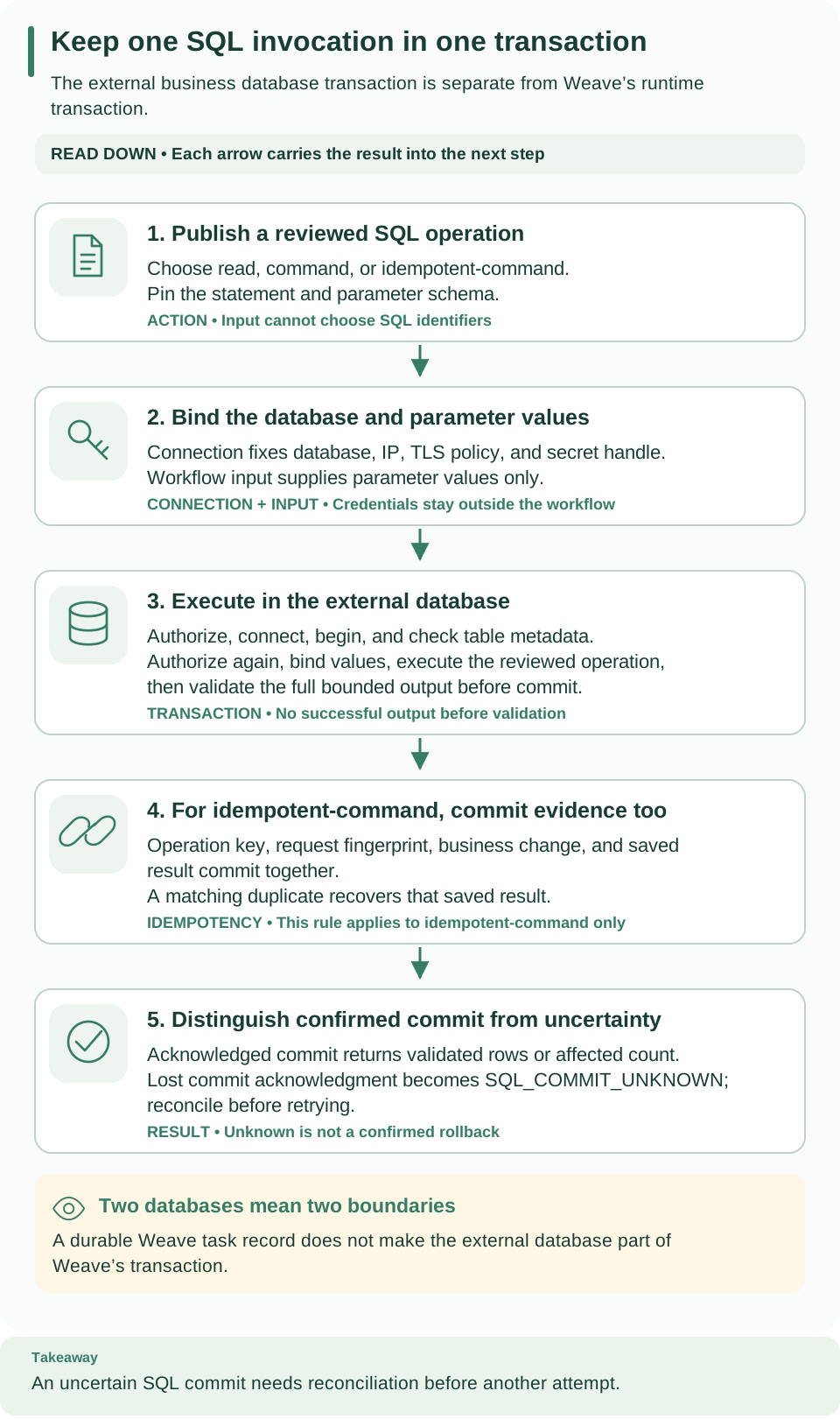
How to read this diagram: Read down from the reviewed operation and connection to the external transaction and its result. Step 4 applies only to idempotent-command; ordinary commands do not gain that protection. A lost COMMIT acknowledgment remains unknown even after cleanup.
Choose the action
The connector has three actions. Each one has its own reserved capability
weave-connector-postgresql-<action>@1.0.0 and its own descriptor binding;
releases and credential grants must authorize that exact capability and
connection revision.
| Action | Statement | Side effect | Connection role |
|---|---|---|---|
read |
SELECT |
read_only |
read: a dedicated login with no write grants, default read-only; runs in BEGIN READ ONLY |
command |
INSERT, UPDATE, or DELETE |
non_idempotent |
command: a dedicated command login |
idempotent-command |
INSERT, UPDATE, or DELETE |
idempotency_key |
command, plus the operation ledger |
The connection's role selects the connector's access profile; it is not a
PostgreSQL role name. A read Action needs a read connection, and the command
actions need a command connection; any other pairing fails with SQL_CONFIG
before connecting.
First lookup: from connection to rows
This walkthrough publishes a bounded, read-only customer lookup. Its success criterion is an expected row result from the approved database; compiling the Action alone does not query that database. The publication sequence explains each ID you will collect, and native worker admission explains executor releases.
-
Agree on the database facts. Ask the database owner for a reviewed
business.customerstable, a dedicated read login, the server's canonical IP address and port, the database name, and the trusted TLS CA. Check the table restrictions before granting access. -
Prepare the platform (operator). Put the password behind an operator-scoped secret handle, here
customer-db-password. Publish the installed Connector:weave connector descriptor weave-postgresql --output jsonprints the platform's installed descriptor (in a CLI from the current source), and itssourcefield is the exact publication source forweave definitions publish --collection connectors, wrapped as{"format": "json", "source": ...}. Register the executor release with the descriptor's capabilities and bindings, and allow the private network if the address is private (see Connection and destination policy). -
Create the connection. Use the returned Connector version ID in this complete request:
{
  "name": "customer-db",
  "connector_version_id": "00000000-0000-4000-8000-000000000001",
  "config": {
    "dialect": "postgresql", "host": "10.20.0.15", "port": 5432,
    "database": "customers", "user": "weave_reader", "role": "read", "tls": "verify-full"
  },
  "secretRef": {"password": "customer-db-password"},
  "allowed_destinations": ["postgresql://10.20.0.15:5432"]
}
# Create the connection revision from the reviewed request file. weave connections create --request customer-db.json --output jsonExpected: a connection revision whose
idis the connection revision ID. The UUID and address above are placeholders; the certificate must cover the actual IP. Then grant the release the connection's credentials withweave workers grantand the capabilityweave-connector-postgresql-read@1.0.0.weave connections test IDconnects with the password and runsSELECT 1; it proves reachability and authentication, not this query's privileges or a supported table shape. -
Publish the Action and a workflow. Publish
postgresql.action.yaml(sql.lookup-customer@1.0.0) withweave definitions publish --collection actions, wrapping the file as{"format": "yaml", "source": ...}. A workflow calls it through a connection slot; this one compiles against that Action:{ "apiVersion": "weave/v1alpha1", "kind": "Workflow", "metadata": {"name": "customer-lookup", "version": "1.0.0"}, "spec": { "connections": {"customers": {"connector": "weave-postgresql@1.0.0"}}, "inputSchema": {"type": "object", "properties": {"customerId": {"type": "string", "maxLength": 128}}, "required": ["customerId"], "additionalProperties": false}, "outputSchema": {}, "steps": [{"id": "lookup", "kind": "action", "uses": "sql.lookup-customer@1.0.0", "connection": "customers", "with": {"object": {"parameters": {"object": { "customerId": {"ref": "/input/customerId"}, "rowLimit": {"literal": 10}}}}}}], "output": {"ref": "/steps/lookup/output"} } } -
Activate and run. Activate the workflow with
connection_revision_idsmappingcustomersto the connection revision ID andconnector_release_idsmapping the Connector version ID to the admitted release, then start a run with{"customerId": "customer-123"}. The step's Action input is then:Expected: a matching row produces
{"rowCount":1,"rows":[{"customer_id":"customer-123","status":"active"}]}, and no match produces{"rowCount":0,"rows":[]}. Actual row values come from your table.
If the step fails, read the fixed SQL code in the run incident and use
Troubleshoot. For SQL_COMMIT_UNKNOWN, reconcile the external
operation before retrying; the lookup is read-only, but commands have different
recovery rules below.
How a call runs
An invocation receives its statement and parameter schema from the published,
pinned Action. Its input contains only parameters; values never become
identifiers. Each invocation owns one database connection and one explicit
external transaction, independent of the platform's own transactions. The native
PyFly service uses constructor injection; it keeps resource limits, never an
actor, lease, secret, or connection.
PostgreSQL is the only implemented driver. There is no portable-SQL claim and no Oracle, MySQL, or SQL Server adapter.
Supported grammar
The PostgreSQL profile accepts one fully consumed statement. It tokenizes at most
16 KiB and 1,024 tokens, then emits SQL from parsed operations, identifiers, and
positional value binds. Tokens are ASCII, identifiers are unquoted and folded to
lowercase, and every relation is explicitly schema.table.
SELECT customer_id, status FROM business.customers
WHERE customer_id = :customerId LIMIT :rowLimit
INSERT INTO business.customers (customer_id, status) VALUES (:customerId, :status)
UPDATE business.customers SET status = :status WHERE customer_id = :customerId
DELETE FROM business.customers WHERE customer_id = :customerId
SELECTpermits optional equality predicates joined byANDand an optional boundLIMIT.UPDATEandDELETErequireWHERE. Commands permit explicitRETURNINGcolumns.- Lists and predicates are limited to 64 entries. Repeated named values share a
positional bind; the Action's
parametersschemas and input names must match exactly.
Rejected syntax includes literals, comments, semicolons, quoted identifiers,
SELECT *, functions, casts, CTEs, joins, subqueries, OR, DDL, COPY, CALL,
session or role changes, and transaction control. This intentionally small
grammar is not a general SQL parser. Unsupported queries must be redesigned or
await another reviewed profile.
Tables the connector accepts
- Only ordinary, non-owned tables without inheritance, row-level security, or rules.
- Columns must use the reviewed built-in scalar types; domains, arrays, JSON, custom types, and generated columns are unsupported.
- Commands additionally reject user triggers, check, foreign-key, and exclusion
constraints, and expression or partial indexes.
INSERTrejects tables with defaults or identity columns (ALWAYSandBY DEFAULT). Primary and unique keys andNOT NULLare allowed. - The connection's login may not be a superuser or have
CREATEDB,CREATEROLE, replication, orBYPASSRLS. Areadlogin must have no table or column write grants, and its default transactions must be read-only.
The connector takes a table lock before metadata checks. Operators must own and review schema changes and maintain least privilege; this is not protection against a malicious database administrator. Parsing alone cannot prove arbitrary database side effects absent. Extending this profile to triggers, sequences, or functions requires explicit treatment of effects that rollback cannot reverse.
Connection and destination policy
The connection config has exactly dialect, host, port, database, user,
role, and tls. secretRef contains only password. allowed_destinations
contains exact postgresql://IP:port origins, with IPv6 brackets where needed.
Only canonical IP literals are supported in this release. DNS names, URLs and
DSNs, paths, sockets, host lists, and DSN query options are rejected. The driver
receives an explicit host, port, database, user, password, and TLS setting, and
/dev/null as its password file; external connections never fall back to the
platform database or an environment DSN.
| Operator variable | Meaning | Default |
|---|---|---|
WEAVE_POSTGRES_CA_FILE |
CA bundle used to verify the server certificate | System trust |
WEAVE_POSTGRES_PRIVATE_NETWORKS |
JSON CIDR array of private ranges the connector may reach | [] |
WEAVE_POSTGRES_PLAINTEXT_NETWORKS |
JSON CIDR array where tls: disable is allowed, for an explicitly permitted local deployment only |
[] |
WEAVE_POSTGRES_MAX_CONNECTIONS |
External invocations that may own a connection at once, per process (1–64) | 8 |
- TLS.
tls: verify-fullis the default; both the certificate chain and the IP SAN are verified. Connection authors cannot select certificates or disable verification. - Addresses. Link-local and metadata, multicast, unspecified, and reserved destinations stay denied under the shared address policy. HTTP destination validation remains HTTP-specific and unchanged.
- Capacity. Semaphore waits consume the attempt deadline. Connections are never pooled or shared by URL, role, revision, or credential version. The connect timeout is 5 seconds, bounded by the remaining attempt budget. A separate 2-second cleanup budget attempts rollback and close, then terminates the socket. These are process-local limits, not cluster-wide capacity admission.
Bounds and mappings
The Action config sets statementTimeoutMs (1–30,000, default 10,000), maxRows
(1–10,000, default 100), maxBytes (32–1,048,576, default 1 MiB), and
mappings. The outer attempt deadline bounds acquisition, metadata, statement,
fetch, and commit together. A transaction-local PostgreSQL statement timeout
applies to each command; zero never disables it.
The driver fetches one row at a time, checks the row cap and the exact serialized
UTF-8 JSON envelope, and validates the Action output before COMMIT. It fails on
overflow; RETURNING overflow rolls back the command. No partial success is
returned. rowCount means returned rows when RETURNING or SELECT produces
columns; otherwise it is the affected count from the validated command tag. It
does not count every indirect effect, and streaming does not cap affected rows or
server work.
| Database value | Required mapping | JSON value |
|---|---|---|
| numeric/decimal | decimal |
Exact finite decimal string |
| date | date |
ISO date string |
| timestamp/timestamptz | datetime |
ISO string; preserves available offset |
| time/timetz | time |
ISO string |
| bytea | base64 |
Standard base64 string |
| UUID | uuid |
UUID string |
Null stays null. Primitive text, boolean, integers, and finite floats need no mapping. Mapping or type mismatches, non-finite values, and unsupported values fail. Binary, temporal, and decimal parameter coercion is not implicit: task values must match the driver-inferred bind type; this profile primarily supports JSON scalar binds.
Memory limit: the driver can decode a single large field before Python can reject it. The 1 MiB bound controls retained and accepted output, not arbitrary peak process memory. Approved database projections, field constraints, and process isolation are needed when database data is untrusted or unbounded.
Idempotency, authority, and ambiguous outcomes
The operation ledger. idempotent-command needs this ledger in the external
database. Provision it with a separate schema owner; the connector never creates
schemas or tables. Grant the command login USAGE on the schema and SELECT,
INSERT, and UPDATE on this table only. Keep it an ordinary table without
triggers, custom types, defaults, or rewrite policies.
CREATE SCHEMA weave_connector;
CREATE TABLE weave_connector.operations (
  scope text NOT NULL,
  operation_key text NOT NULL,
  request_hash text NOT NULL,
  result jsonb,
  PRIMARY KEY (scope, operation_key)
);
- The scope is the immutable, globally unique connection revision ID, which the platform binds to the tenant, project, and environment.
- The fingerprint covers the pinned Action identity, the reviewed config, and the full input. The unique operation record, the business change, and the bounded result commit together.
- Concurrent duplicates wait on that unique record and recover the saved result.
Reusing a key for a different request fails with
SQL_IDEMPOTENCY_CONFLICT. - A new revision is a new idempotency namespace. Do not discard or change ledger records while deliveries may recur. No library or application retry silently re-executes a business command.
Authority checks. Before connecting, before the business statement, and
immediately before COMMIT, the connector requires the active invocation's
ActionContext.authorize callback. Native execution rechecks the live lease, the
exact saved pins, the current principal, the release capability, and the
unrevoked connection grant without secret-provider I/O. The callback fails closed
when absent and expires when the invocation exits. A denial before COMMIT rolls
back. Credentials are resolved once per invocation.
There is an unavoidable cross-database check-to-COMMIT race: a revocation
committed after the final authorization check cannot atomically cancel the
external commit. No distributed transaction or instantaneous revocation guarantee
is claimed.
Ambiguous commits. Any timeout, cancellation, or transport failure after
entering COMMIT without an acknowledgment yields SQL_COMMIT_UNKNOWN with
outcome unknown; a later rollback or socket cleanup never proves that the
commit did not happen. Unsafe command recovery opens WV-TASK-AMBIGUOUS;
operators reconcile before replay. Idempotent commands can safely recover the
ledger on an authorized redelivery; this connector does not retry them
automatically. Earlier cancellation propagates after cleanup. Stable failures
carry codes only, never driver text, SQL, bind values, or credentials.
Troubleshoot
| What you see | Why | What to do |
|---|---|---|
SQL_CONFIG |
The Action config is invalid, the statement does not match the action, or the connection role does not match the action |
Pair read with a read connection and commands with a command connection; check the statement against the grammar |
SQL_INPUT |
The input is not exactly {"parameters": {...}} with every statement parameter, or a value fails its schema |
Compare the step's input with the Action's parameters schemas |
SQL_TLS |
tls: disable was used for an address outside WEAVE_POSTGRES_PLAINTEXT_NETWORKS |
Use verify-full, or have the operator permit that local address |
SQL_AUTH |
The stored password is empty or too long | Store a corrected value behind the same handle |
SQL_ROLE |
The login has elevated attributes, a read login can write, or the database denied the statement |
Ask the database owner to apply least-privilege grants |
SQL_RELATION or SQL_TYPE |
The table or one of its columns is outside the accepted shapes | Use a reviewed table or projection that fits the profile |
SQL_MAPPING |
A returned column needs a mapping, or a value does not match its mapping | Add the required mapping from the table above |
SQL_RESULT_LIMIT or SQL_OUTPUT |
The rows or bytes exceed maxRows or maxBytes, or the result fails the output schema |
Narrow the query, raise the limits within bounds, or fix the output schema |
SQL_IDEMPOTENCY_CONFLICT |
An operation key was reused for a different request | Investigate the earlier operation before sending a new one |
SQL_AUTHORITY |
An authority check before connecting, before the statement, or before COMMIT failed: the lease, pins, release capability, or connection grant is missing or changed |
Check the release's weave workers grant for this connection revision and capability, and the executor's worker role |
TIMEOUT |
The attempt deadline, the statement timeout, or a lock wait ran out | Check statementTimeoutMs, the Action's timeout, and locks on the table |
SQL_STATUS |
The database returned an unexpected command tag; the transaction was rolled back | Check the table against the accepted shapes before running the command again |
SQL_FAILED |
Another database or transport failure; the code is the only detail | Check the database logs and reachability; weave connections test ID checks login and SELECT 1 |
SQL_COMMIT_UNKNOWN |
The commit acknowledgment was lost | Reconcile in the database, then resolve the incident; see incident operations |
Next steps
- Put the lookup in a process with a decision or an approval: Author workflows and Human tasks and approvals.
- Understand releases, grants, and activation pins: From package to an executable workflow.
- Call an HTTP API in the same workflow: Call a REST API without code.