Inspect run history and replay it offline
History is the ordered record of facts Weave accepted for a run: it started, an action completed, a signal arrived, a timer elapsed. Replay feeds those facts back through the same pure runtime kernel to check that they tell a consistent story. Replay sends no messages, executes no actions, and does not resume the run. To start a new execution instead, see run retry.
Who it is for. Operators investigating a run, and developers who audit or
debug executions. What you need. Studio or the CLI connected to a platform
(connect the CLI), the run's id (from its start
response, or a trigger or provider receipt), and run.read in that environment
(the viewer role). For offline replay, also the exact compiled artifact the run
used. Allow 10 minutes.
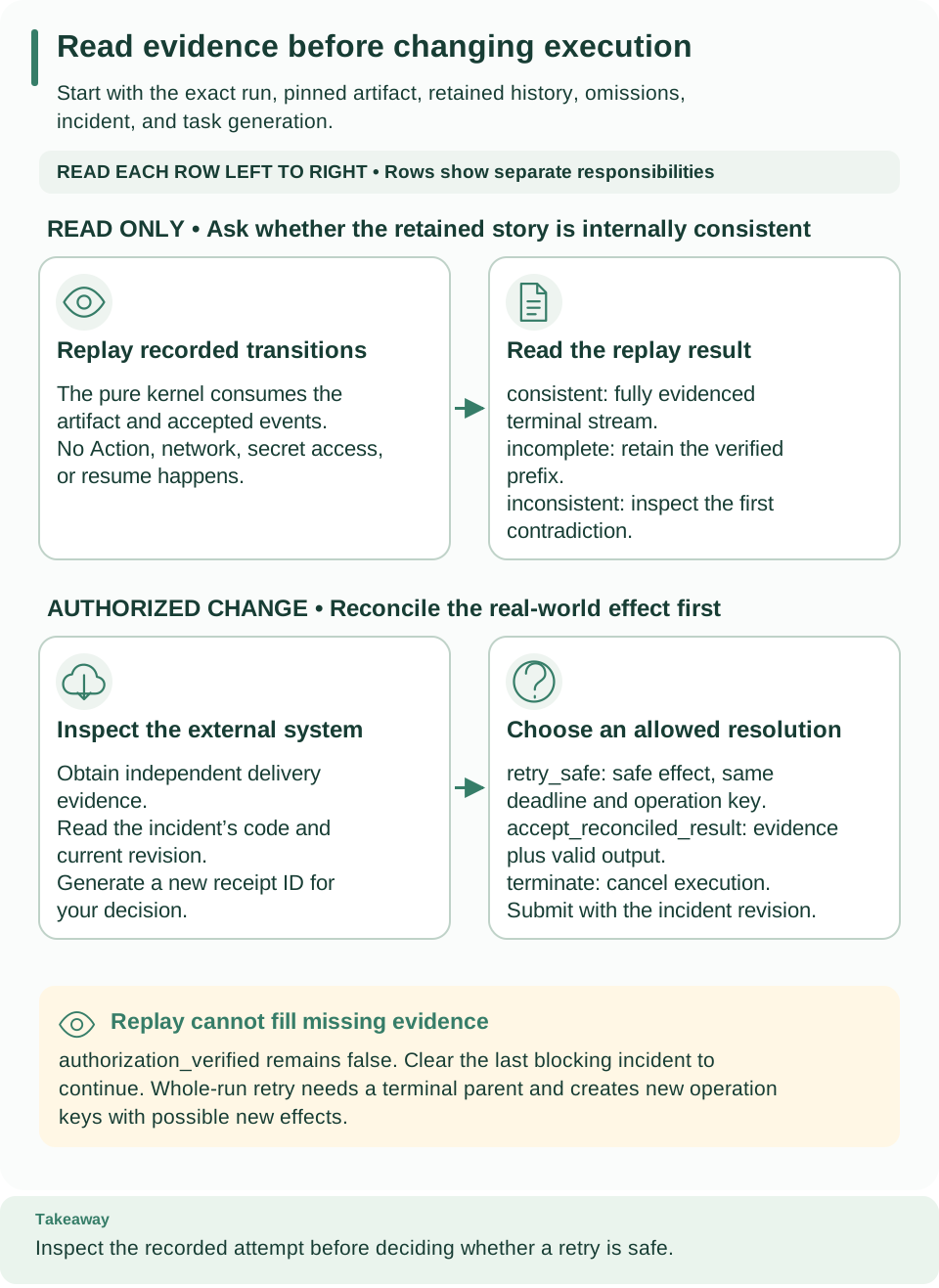
Follow the top row left to right for read-only replay and its result. A consistent report describes the retained evidence of a finished run; it does not independently prove delivery or past authorization. The lower row is a separate, authorized decision that changes execution. Open diagram at full size
Read a run's history
In Studio, open Runs, select a run, and read its Timeline: the first page of its accepted facts (up to 100) as plain sentences, such as "Run started". View raw event shows a fact as it was recorded. The run's Now line explains why it waits, for example "Waiting for a signal at STEP", where STEP is the step's ID. A run blocked by an incident shows "This run stopped at STEP." instead.
From the CLI, run the commands with a saved platform and workspace from
weave auth setup (see
how remote commands choose a platform).
Saved platforms are new in 0.1.0a7; with an alpha6 or earlier CLI, these
commands use explicit mode.
# Read the first page of accepted facts for one run.
weave runs history RUN_ID --limit 100 --output json
Expected: an event page with run_id, scope, high_water_sequence, events,
and next_cursor. When next_cursor is not null, pass it unchanged with
--cursor to read the next page. Do not compute sequence offsets yourself.
Check that the history is consistent
Choose where the check runs.
On the platform. The server replays the run with the artifact it pinned. It
replays the same bounded evidence as an export (at most 1,000 facts, or fewer
with --limit):
# Ask the platform to replay the run's recorded facts with its pinned artifact.
weave runs replay RUN_ID --output json
Expected: a replay report (described below). It needs only run.read.
Offline, on your computer. Use this when you want an independent check with an artifact you keep:
-
Export the run's evidence:
# Export up to 1,000 accepted facts with source references and completeness metadata.
weave runs export RUN_ID --output json > history.json
Expected: a JSON document with
version: weave/history-v1,events,artifact_digest, andomissions. The export never includes the artifact itself. -
Get the exact artifact the run used. Use the
compiled-artifact.jsonyou kept when you compiled and published that version, or read the published version. ItsVERSION_IDisactivation.request.version_idinweave runs read RUN_ID --output json:# Save the compiled artifact of the published version the run is pinned to. weave definitions export VERSION_ID --collection workflows --output json \ | python3 -c 'import json,sys; json.dump(json.load(sys.stdin)["artifact"], sys.stdout)' \ > pinned-artifact.jsonThen compare the artifact's
digestwith the export'sartifact_digest; they must be equal. A current source file with the same name is not a substitute. -
Replay locally:
# Replay the exported facts with the pinned artifact; no network, database, or executor is used.
weave run replay --artifact pinned-artifact.json --events history.json
Expected: a replay report and exit code
0when it isconsistent,1when it isincompleteorinconsistent. A nonzero exit is a verdict about the evidence, not a sign that the live run failed.
Release tooling should keep each published artifact with its release evidence, so offline replay is always possible.
Read the replay report
The report has status, diagnostics (each with code and sequence),
last_verified_sequence, final_state, omissions, and
authorization_verified, which is always false.
| Status | Meaning | What to do next |
|---|---|---|
consistent |
A fully evidenced, finished stream whose transitions agree | Nothing; this proves internal consistency, not external delivery or past authorization |
incomplete |
The run is still open, the export was bounded, or evidence is missing or withheld | Check whether the run is still running or the export hit its limit; keep the verified prefix |
inconsistent |
The artifact, the event stream, or a transition does not match | Confirm you used the exact artifact and stream, then read the first diagnostic; never edit history to make it agree |
last_verified_sequence and final_state describe only what replay could
verify. Sequence gaps and unavailable operands stop at the verified prefix. These
make a report inconsistent: the wrong artifact, lock, or source identity;
duplicate accepted receipt identities; invalid event envelopes; invalid signal
arbitration; or a transition that differs from the recorded one. A run suspended
by a legitimate kernel incident remains an inspectable, verified prefix.
Routes, pagination, and limits
All routes are under
/api/v1/tenants/{tenant}/projects/{project}/environments/{environment}/runs/{id}
and need current run.read:
| Route | CLI | Returns |
|---|---|---|
GET .../history?limit=1..100&cursor=… |
weave runs history |
One EventPage; default limit 100 |
GET .../export?limit=1..1000 |
weave runs export |
One HistoryExport; default limit 1,000 |
GET .../replay?limit=1..1000 |
weave runs replay |
One ReplayReport from the server's pinned artifact, over the same bounded evidence as the export; default limit 1,000 |
Stable pages. A history cursor binds the full scope, the run, the last
sequence, and the high-water sequence of the first page, so facts appended later
do not enter that traversal. Every page reloads your current run.read; knowing
a cursor grants nothing.
Late completions. An export also lists up to 100 ignored late completion
receipts in a separate, ordered auxiliary_receipts section. The run lock and
auxiliary_high_water define that snapshot, and auxiliary_complete: false says
it was truncated; it has no pagination. Ignored receipts never enter the accepted
sequence.
Source references. An export names the original scoped version, source hash, source format, source map, and the IR node paths. Republishing the same executable with new formatting does not change that reference. Missing or ambiguous source provenance makes the export explicitly incomplete. Filenames in a source map are labels: the service never opens them and never includes source text or an artifact.
Size limits. Inspection limits do not cap how long a run may live.
- Pure replay accepts at most 10,000 events and 64 MiB of artifact plus events. It checks each transition's size before hashing a reconstruction larger than 64 MiB and returns an incomplete verified prefix.
- Export streams rows and bounds the whole output, including maps, auxiliary
receipts, and replay state, to 64 MiB, measured field by field. An oversized
final state is withheld with a
resource_limitomission, an incomplete status, and the last verified sequence kept. - These are input and output bounds, not limits on kernel CPU or process memory; runtime state and transitions have their own budgets.
replay(artifact, tuple(events)) in Python calls the same public kernel
transition as production and never regenerates outcomes. The strict
event-page, history-export, recorded-evidence, and replay-report schemas
are written by weave schema export --directory DIR. The older
weave run history and weave run export commands still work with
--environment-url (or WEAVE_ENVIRONMENT_URL) and WEAVE_ACCESS_TOKEN.
What the evidence contains
New facts carry optional weave/recorded-v1 evidence in an append-only, scoped
sidecar, committed in the same transaction as the fact:
- The start fact keeps the safe initial input. Every fact binds the run, the scope, the executable and dependency identity, and the exact source reference.
- Newly issued task and wait UUIDs map to kernel command nodes and to pinned action, release, and deadline facts. Receipts bind the generation and the selected wait, and bounded signal metadata records how signals were arbitrated.
- The expected transition is the SHA-256 of a canonical
classified-v1safe projection of the kernel state, identified assha256-rfc8785-v1; no duplicate snapshot is stored. - Lease tokens, output fingerprints, and free-form operator reasons or evidence
strings are never exported. Typed omissions distinguish a withheld value from a
genuine
null.
The secret classification policy still governs values and artifacts, including its limit on unmarked business data.
Task timing. Task receipts can carry timing evidence:
live_admissionrecords the single databasechecked_attime of the final locked lease check and that attempt'seffective_deadline. The issued task keeps its original deadline; claiming may shorten the effective deadline to the overall run deadline. Replay requires admission strictly before the effective deadline and checks that neither issued bound was extended. A fact's own timestamp is not its admission time.recovery_decisionrecords when recovery decided. A scheduled retry must be at or after that time and strictly before the effective deadline; a recovery incident may be recorded after the deadline. Recovery retires its generation: only the next generation can supply an outcome, never before the recorded retry time. A manual safe retry also allows only its successor.- Missing timing in older sidecars makes replay incomplete; contradictory timing or lifecycle facts make it inconsistent.
What replay cannot prove. Existing facts are never rewritten. Missing initial
input, identity, or issuance provenance stays incomplete; this version does not
fill it from snapshots. A policy-blocked run shows only safe metadata and explicit
omissions. A sidecar's presence does not prove completeness. Recorded facts
establish internal consistency, not independent proof of historical leases or
identity-provider authorization, which is why authorization_verified is always
false.
Oversized finished runs. A terminal control on an oversized run can keep its
full transition in PostgreSQL while omitting the optional expected-transition
digest with reason resource_limit. Replay then stays incomplete: a committed
cancellation or timeout does not by itself prove a fully replayable stream, and
earlier facts are never rewritten to fill the gap.
Next steps
- Incident operations: decide what to do when history shows an uncertain action.
- Implement and operate a worker: leases, completions, and recovery.
- Manage executions and business cases: find, archive, and purge runs.
- Simulate a workflow run: try the same workflow with mocks before it runs for real.
Troubleshooting
| What you see | Why | What to do |
|---|---|---|
inconsistent with an artifact or lock diagnostic |
You replayed with a different artifact | Use the artifact whose digest equals the export's artifact_digest |
incomplete for a run that is still running |
Open runs are never fully evidenced | Replay again after the run finishes |
incomplete with WV-REPLAY-BOUNDED-PREFIX |
The run has more accepted facts than the export or replay limit (at most 1,000); the platform replay has the same bound | Keep the verified prefix: it covers the facts up to last_verified_sequence |
incomplete with WV-REPLAY-LIMIT |
The export reached its 64 MiB size budget, or one fact was too large to include | Keep the verified prefix; the withheld facts are not part of the check |
WV-REPLAY-INPUT: bounded artifact and recorded events required |
A file is not valid JSON, is too large, or has more than 10,000 events | Check both files and their sizes |
HTTP 403 WV-FORBIDDEN |
You lack run.read in that environment |
Ask for the viewer role there; operator alone does not include it |
HTTP 404 WV-NOT-FOUND |
The run belongs to another environment than the selected workspace | Check the Workspace: line of weave auth status, or pass --environment |
auxiliary_complete: false |
More than 100 late completions were ignored | Expected; ignored receipts never change the run |