Prepare AWS EKS and ECR
This guide connects your terminal to an existing EKS cluster and to private ECR repositories, so that the shared guides can build, push, and deploy Weave. It configures your client tools only; it creates no cloud infrastructure.
Who this is for: an operator with an approved AWS profile, access to the cluster, permission to push to ECR, and a network path to the Kubernetes API endpoint.
What you need first: AWS CLI v2, kubectl, Docker, and Python 3, with the AWS
CLI signed in through your organization's approved profile. In the same terminal,
load your local installation's session.env as described in the
cloud deployment overview,
so that WEAVE_DOCKER_CONTEXT is set.
What you will have at the end: KUBECONFIG, WEAVE_KUBE_CONTEXT,
WEAVE_KUBE_NAMESPACE, and WEAVE_REGISTRY_PREFIX set in this terminal.
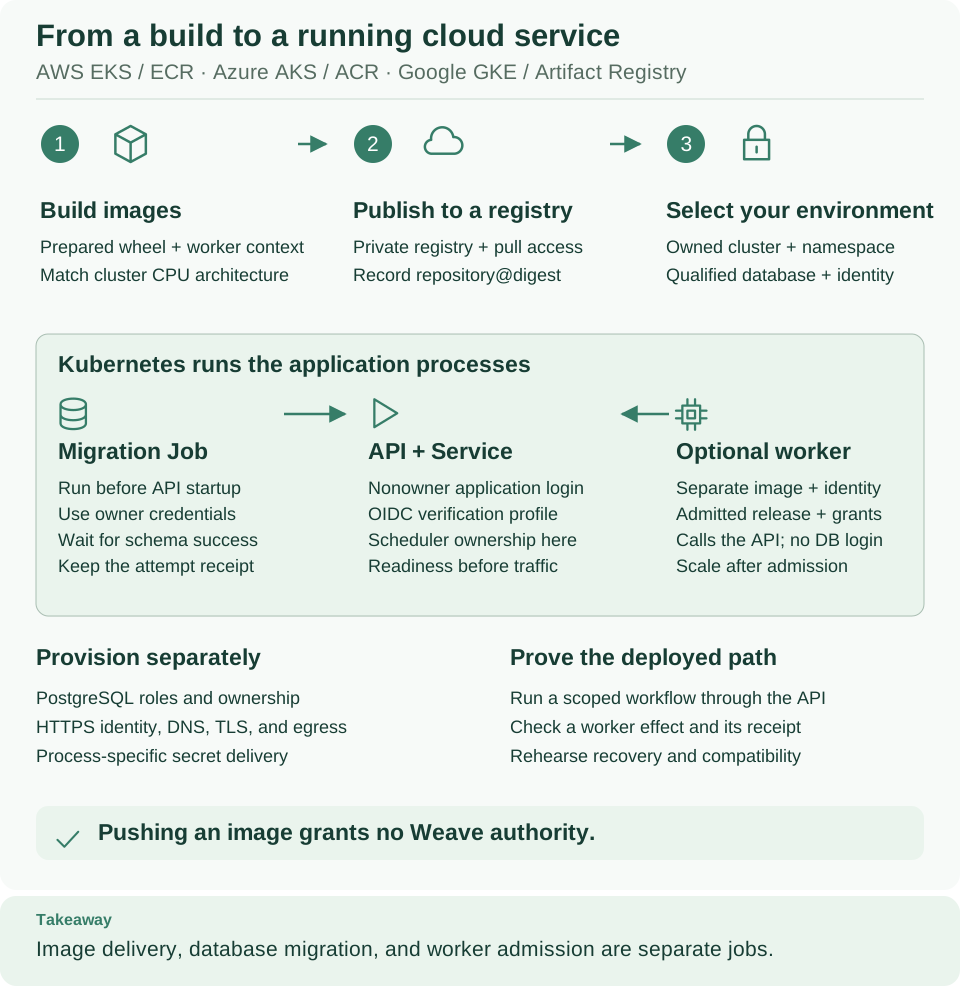
ECR sits at the image boundary (step 2 in the diagram) and EKS runs the green panel. Your AWS access to those services is separate from the Weave principal and grants that the API checks. Open diagram at full size
If you do not have infrastructure yet
Use the provider's AWS cluster creation guide to prepare an approved cluster with its network, node capacity, and access controls. Provision the registry and the intended namespace through the same infrastructure process, then return to step 1 with the real resource names. These resources cost money, and a provider quickstart is a learning baseline, not a production availability or security design for Weave.
1. Select the account and actual resources
Why: every later command depends on the right account, region, and cluster.
Replace every your-* value with the existing resource names from your operator.
This example uses the standard AWS commercial partition and an ECR registry in the
same account as the signed-in operator.
# Select the AWS account and region, then inspect the existing cluster before changing local configuration.
export AWS_PROFILE='your-approved-profile'
export AWS_REGION='your-cluster-and-registry-region'
export WEAVE_EKS_CLUSTER='your-existing-cluster'
aws sts get-caller-identity
aws eks describe-cluster --region "$AWS_REGION" --name "$WEAVE_EKS_CLUSTER" \
  --query 'cluster.{name:name,arn:arn,status:status,endpoint:endpoint}' --output json
Expected: the account you intended, and the cluster with status ACTIVE. Check
that the cluster ARN matches the intended environment. Reading the cluster needs
eks:DescribeCluster; using Kubernetes also needs the cluster's access mapping
and RBAC, because an AWS identity alone grants no Kubernetes permissions. See
AWS cluster access instructions.
2. Configure and explicitly select kubectl
Why: a separate, private kubeconfig keeps your other cluster connections untouched. AWS's command writes the configuration and selects its new context; the commands below still name that context explicitly. See update-kubeconfig.
# Keep this cluster connection in its own private kubeconfig so your other contexts are preserved.
umask 077
export WEAVE_PROVIDER_DIR="$HOME/weave-aws-$(python3 -c 'from uuid import uuid4; print(uuid4().hex)')"
mkdir -m 700 "$WEAVE_PROVIDER_DIR"
export KUBECONFIG="$WEAVE_PROVIDER_DIR/kubeconfig"
aws eks update-kubeconfig --region "$AWS_REGION" --name "$WEAVE_EKS_CLUSTER" \
  --kubeconfig "$KUBECONFIG"
kubectl config get-contexts
Expected: a context named after the selected EKS cluster ARN. Copy its exact name
into WEAVE_KUBE_CONTEXT below, never an unrelated current context. Then name the
namespace reserved for Weave and check what you may do there:
# Select the exact context and namespace, then confirm access and the node CPU architecture.
export WEAVE_KUBE_CONTEXT='your-exact-context-name-from-the-list'
export WEAVE_KUBE_NAMESPACE='your-existing-namespace'
kubectl --context "$WEAVE_KUBE_CONTEXT" -n "$WEAVE_KUBE_NAMESPACE" auth can-i create deployments
kubectl --context "$WEAVE_KUBE_CONTEXT" -n "$WEAVE_KUBE_NAMESPACE" auth can-i create jobs
kubectl --context "$WEAVE_KUBE_CONTEXT" -n "$WEAVE_KUBE_NAMESPACE" auth can-i create secrets
kubectl --context "$WEAVE_KUBE_CONTEXT" get nodes -L kubernetes.io/arch
Expected: yes three times, then the nodes with an architecture label such as
amd64 or arm64. Build for that architecture in the shared guide: an image
built on an Apple silicon laptop is not automatically an AMD64 image. If your role
cannot list nodes, ask the operator for the node pool's architecture and
placement rules. A private cluster needs an approved network path from this
terminal.
3. Authenticate Docker to existing repositories
Why: the shared guide pushes weave/server and, for a remote worker,
weave/worker. Each needs an existing ECR repository, which the registry
administrator creates with the right push and pull policies. Docker signs in
with a token passed directly from the AWS CLI, as in
AWS's ECR push procedure.
# Authenticate Docker to the existing ECR repositories; this uploads no images yet.
export WEAVE_AWS_ACCOUNT_ID="$(aws sts get-caller-identity --query Account --output text)"
export WEAVE_ECR_HOST="$WEAVE_AWS_ACCOUNT_ID.dkr.ecr.$AWS_REGION.amazonaws.com"
aws ecr describe-repositories --region "$AWS_REGION" \
  --repository-names weave/server weave/worker \
  --query 'repositories[].repositoryUri' --output json
: "${WEAVE_DOCKER_CONTEXT:?Load your local session.env as described in the cloud overview}"
aws ecr get-login-password --region "$AWS_REGION" | \
  docker --context "$WEAVE_DOCKER_CONTEXT" login \
  --username AWS --password-stdin "$WEAVE_ECR_HOST"
export WEAVE_REGISTRY_PREFIX="$WEAVE_ECR_HOST/weave"
Expected: both repository URIs, then Login Succeeded. Stop if a repository you
need is missing. For an API-only rollout, remove weave/worker from the
describe-repositories command: it reports an error for a repository that does
not exist.
Pushing and pulling are separate permissions. The build operator needs ECR authentication and image upload rights. The EKS nodes, or the Fargate pod execution role, need their own ECR read access: your Docker sign-in on a laptop gives the cluster nothing. A registry in another account needs that registry account selected explicitly, with matching policies, instead of the same-account address built above.
4. Choose supporting services deliberately
| Requirement | AWS option | Weave boundary |
|---|---|---|
| PostgreSQL | RDS for PostgreSQL or separately operated PostgreSQL | Rehearse the exact migrations and role and function ownership on the chosen service; local PostgreSQL tests do not certify RDS |
| Secret storage | AWS Secrets Manager through an operator-managed delivery mechanism | Delivering values into processes is not a Weave secret-provider implementation; this guide installs no native AWS provider |
| Token issuer | Your compatible HTTPS OIDC/CIAM provider (configuration) | Configure and verify issuer, audience, and JWKS, and create Weave identity links and grants; AWS IAM access is not a Weave grant |
RDS's administrative role is not an unrestricted PostgreSQL superuser. Before you deploy, pass the database qualification gate, including role creation, grants, exact role attributes, and function ownership. Never run the local fixture setup script against RDS. See AWS's rds_superuser restrictions.
If something goes wrong
| What you see | Why | What to do |
|---|---|---|
aws eks describe-cluster is denied |
The selected AWS identity lacks eks:DescribeCluster, or AWS_PROFILE selects another account |
Check aws sts get-caller-identity and ask for the permission |
kubectl reports You must be logged in to the server (Unauthorized) |
Your AWS identity has no access entry or RBAC in this cluster | Ask the cluster administrator to grant Kubernetes access to your identity |
kubectl times out |
The cluster endpoint is private and this terminal has no route to it | Use the approved network path, such as a VPN or bastion |
auth can-i prints no |
Your Kubernetes role cannot create that object in the namespace | Ask for the namespace permissions before you continue |
describe-repositories reports a missing repository |
weave/server or weave/worker does not exist in this account and region |
Ask the registry administrator to create it |
Pods later stay in ImagePullBackOff |
The nodes' role cannot read the ECR repository | Grant ECR read access to the node or Fargate pod execution role |
Continue with the shared deployment
Keep KUBECONFIG, WEAVE_KUBE_CONTEXT, WEAVE_KUBE_NAMESPACE, and
WEAVE_REGISTRY_PREFIX in this terminal, then:
- Return to the cloud deployment overview to pass the readiness gate, then build, push, and record the registry digests.
- Use the Kubernetes walkthrough for database qualification, the migration Job, the API rollout, and a verified run.
These provider commands neither publish a workflow nor admit a worker release. The CLI tutorial covers that separate application lifecycle.