Call HTTP APIs and accept signed webhooks
HTTP traffic crosses Weave in two directions. Outbound, an HTTP connector action calls another system while a run executes. Inbound, a signed webhook trigger lets your system start a run, or signal a waiting one, by posting a signed JSON envelope. You can use either one without the other.
Who it is for. Integration developers who connect a system to Weave, and operators who run the executor that makes outbound calls. What you need. A platform you can use: the local platform or a standalone setup, and an activated workflow (see workflow authoring). A webhook trigger takes about 15 minutes once a signing secret is granted.
Choose the direction you need
| You want to | Use | Start here |
|---|---|---|
| Call a REST API from a workflow step, without writing code | The built-in weave-http@2.0.0 connector |
Call a REST API without code |
| Use the original minimal HTTP connector (fixed path, bearer or no auth) | weave-http@1.0.0 |
The original HTTP connector |
| Start or signal a run from your own system | A signed webhook trigger | Create a signed run trigger |
| Receive Teams, WhatsApp, or Telegram events | A provider source, with the vendor's own authentication | Provider sources |
| Notify your system when runs or definitions change | An event subscription | Outbound integration events |
| Run connector actions on a shared platform | The native executor | Built native dispatcher setup |
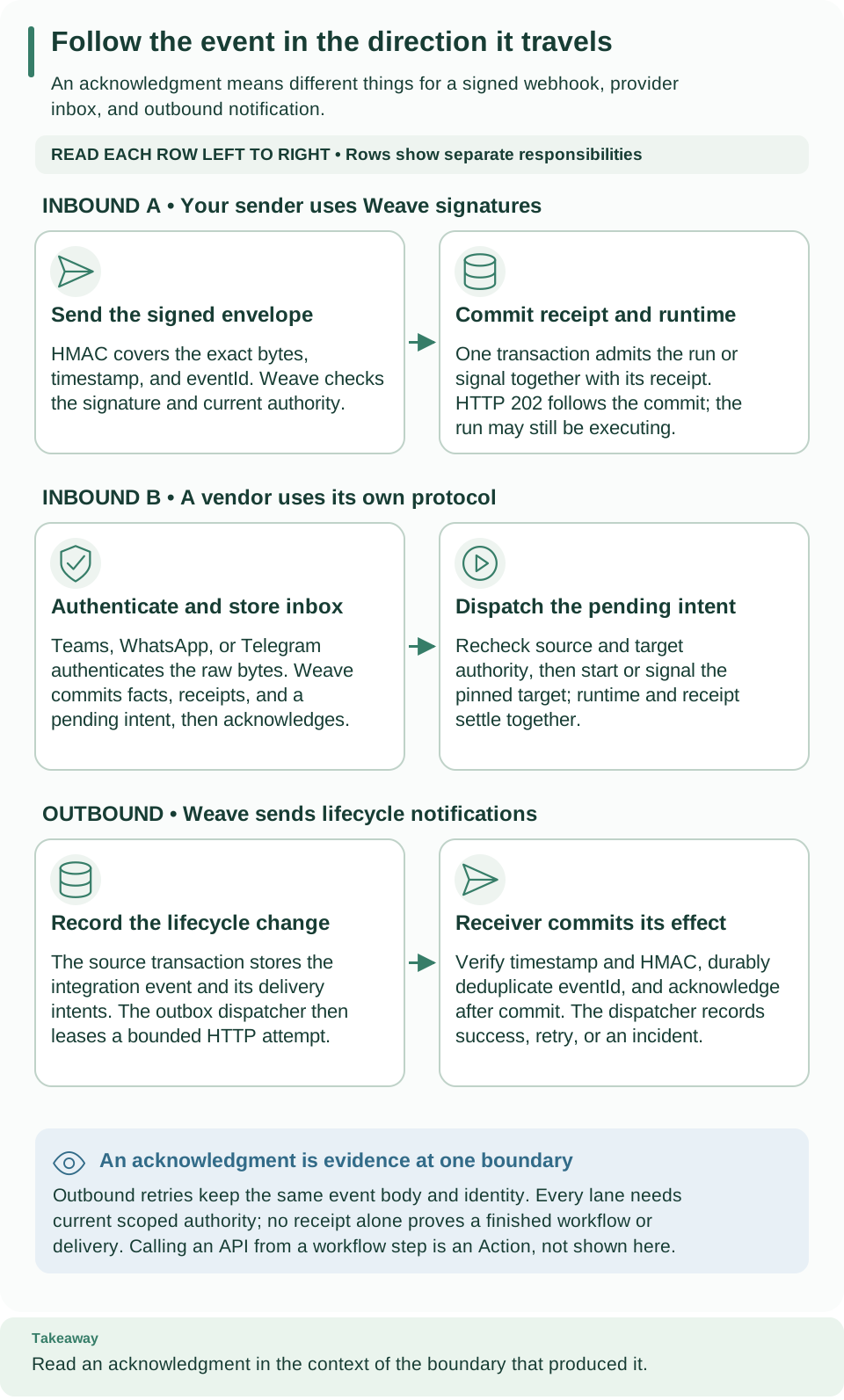
Read one row at a time, left to right. A signed webhook commits its receipt together with the run it starts; a provider event is stored in an inbox first and dispatched later; the bottom row sends lifecycle notifications outward. An acknowledgment means something different in each row. Open diagram at full size
Create a signed run trigger
A trigger is an immutable route that turns one signed HTTP request into a new
run of one activation, or into a signal for one waiting run. You need the
trigger.manage capability (the deployer role) plus run.start for a run
trigger or run.signal for a signal trigger (the operator role). Run the
commands with a saved platform and workspace, set up with weave auth setup (see
how remote commands choose a platform);
saved platforms are new in 0.1.0a7; with an alpha6 or earlier CLI, these
commands use explicit mode.
-
Activate the target workflow. Its input must accept the payload you will send, here
{"customerId": "123"}. Keep the activation'sid: it is not the workflow version ID. -
Ask your operator for a signing secret handle. A secret handle is a name, such as
customer-events-key, that the operator grants to your environment inWEAVE_SECRET_GRANTS; the value stays in the operator's secret store. Give the sender the same key through its own secure configuration. The handle string is not the key. On the local platform, store the value yourself withweave platform secret set --handle customer-events-key, then restart the API so the handle is granted to the demo environment. -
Create the trigger. Save this as
trigger.json, replacing the activation UUID:{ "name": "customer-events", "kind": "run", "activation_id": "00000000-0000-4000-8000-000000000001", "secret_ref": "customer-events-key", "payload_schema": { "type": "object", "properties": {"customerId": {"type": "string"}}, "required": ["customerId"], "additionalProperties": false }, "max_body_bytes": 1048576, "tolerance_seconds": 300 }# Create the immutable trigger in your selected environment. weave triggers create --request trigger.json --output jsonExpected: the request fields plus a server-assigned
id, yourprincipal_id, and"disabled": false. Saveidas the trigger ID. For a signal trigger, use"kind": "signal", leave outactivation_id, and supply the waiting run'srun_idand the declaredsignalname. -
Send a signed event. The sender serializes the envelope once, signs those exact bytes with a timestamp, and posts them to
/webhooks/TRIGGER_ID. This route is outside/api/v1and uses the signature, not a bearer token. This complete Python sender reads the address fromWEBHOOK_URLand the key fromSIGNING_KEYin its own environment:import hashlib import hmac import json import os import time import urllib.request url = os.environ["WEBHOOK_URL"] # https://YOUR_WEAVE_HOST/webhooks/TRIGGER_ID secret = os.environ["SIGNING_KEY"].encode() # the exact bytes behind the handle body = json.dumps({"eventId": "customer-event-123", "payload": {"customerId": "123"}}, separators=(",", ":")).encode() timestamp = str(int(time.time())) signature = hmac.new(secret, timestamp.encode("ascii") + b"." + body, hashlib.sha256).hexdigest() request = urllib.request.Request(url, data=body, method="POST", headers={ "Content-Type": "application/json", "X-Weave-Timestamp": timestamp, "X-Weave-Signature": signature, }) with urllib.request.urlopen(request, timeout=30) as response: print(response.status, response.read().decode())Expected:
202and a receipt withid,trigger_id,event_id,run_id, and, for a signal trigger,signal_id. -
Check what happened. The receipt proves admission, not completion. Read the run:
# Read the run the webhook started; replace RUN_ID with the receipt's run_id.
weave runs read RUN_ID --output json
Expected: the run with its current
status; reading runs needsrun.read(theviewerrole). If it waits on an action, that action needs an admitted worker or executor; if it is suspended, follow incident operations instead of sending a new event.
The sender's signature was checked against the server's verifier code when this page was written. The full webhook journey is covered by the project's end-to-end tests and was not run again for this page.
Signed ingress
Creating and disabling triggers. POST /api/v1/tenants/{tenant}/projects/{project}/environments/{environment}/triggers
creates a trigger (weave triggers create). The creator becomes the trigger's
execution principal; there is no principal selector or delegation. A run trigger
pins activation_id; a signal trigger pins run_id and one declared signal.
max_body_bytes is at most 1 MiB and tolerance_seconds is 1 to 300. Triggers
are immutable: to change a route, create a new trigger. weave triggers disable
ID (POST .../triggers/{id}/disable) needs trigger.manage; weave triggers
list and read show existing ones.
The envelope. Send exact UTF-8 JSON bytes to POST /webhooks/{id}:
The envelope has exactly these two keys. eventId must match
[A-Za-z0-9_.:-]{1,128}, and payload must satisfy the trigger's
payload_schema.
The headers. X-Weave-Timestamp is Unix seconds and X-Weave-Signature is
the lowercase hexadecimal HMAC-SHA256 of the ASCII timestamp, a period, and the
exact body bytes:
X-Weave-Event-ID is optional; when present it must equal the signed eventId.
The key is the exact bytes of the secret value, including any trailing newline
in a mounted file.
What is rejected. A bad or stale signature, a timestamp outside the tolerance, modified bytes, a changed event ID header, duplicate or extra keys, unsafe numbers, invalid Unicode, and excessive nesting. The body is parsed only after the signature is valid. Forwarding headers never select the tenant, trigger, or signing identity.
How authority is checked. The ingress route is the only exception to bearer
authentication, and only for an exact POST with a UUID. A dedicated database
function owner, without login or row-security bypass, looks up just enough of the
route to check the signature; the application cannot read across scopes. After
the signature is valid, the service locks the trigger, checks that it is enabled
and unchanged, reloads its creator's current grants, and writes the receipt and
the run or signal in one transaction. The 202 is returned after commit. A
disabled trigger or a revoked creator fails closed.
Retries and duplicates. The same event ID with the exact same body returns the same receipt, run, and signal IDs, including after a lost response. The same event ID with different bytes returns HTTP 409, even when the JSON means the same thing. A new, properly signed event ID is a new delivery. To retry outside the tolerance window, re-sign the same bytes with a fresh timestamp.
What happens to a webhook and an outbound call
- The sender posts the timestamp and the exact signed envelope.
- Ingress checks the HMAC, the signed event ID, and the size limits.
- In PostgreSQL, the service locks the trigger, checks current authority, and commits the receipt and the run together, with stable IDs.
- Ingress returns
202with the receipt. - Later, the native dispatcher confirms its scoped identity and claims the action's task under a lease.
- It reads the private pinned metadata and, when needed, authorizes the credential.
- It sends one bounded request to the validated, pinned peer.
- It records a fenced completion, advances the run, and stores the receipt.
Delivery of the outbound call is at least once: external I/O happens after the claim commits, and a timeout after a write is ambiguous. There are no HTTP-library retries; retries follow the action's declared policy.
The original HTTP connector (weave-http@1.0.0)
For new integrations, prefer the built-in weave-http@2.0.0: it supports path,
query, and header parameters, API key, basic, bearer, and machine-token
authentication, and the no-code builders in the CLI and Studio. See
Call a REST API without code and
HTTP profiles. The original v1 connector stays
installed, and existing activations keep their behavior. It is also the
connector event subscriptions deliver through.
firefly_weave.connectors.manifest.HTTP_DESCRIPTOR holds the immutable
weave-http@1.0.0 manifest, its weave-http adapter identity, implementation
version, capabilities, and release bindings. Publish that exact manifest through
normal connector publication. Since 0.1.0a7,
weave connector descriptor weave-http --output json asks your platform for its
installed copy; publish that copy's source field unchanged with
weave definitions publish --collection connectors, wrapped in the request file
as {"format": "json", "source": ...} and sent with an --idempotency-key. A
tenant cannot replace its
schema or take the reserved weave-connector-* task namespace with an ordinary
worker release.
Actions. read allows GET and HEAD and is read_only; write allows POST,
PUT, PATCH, and DELETE and is non_idempotent.
Action configuration. An action fixes its config: method, a fixed path,
the accepted 2xx statuses, and optional maxRedirects (0 to 5, default 3).
Paths use slash-separated ASCII letters, digits, underscores, or hyphens, with an
optional trailing slash.
Input and output. Workflow input has only query (string values) and an
optional JSON body; a read rejects a body. Input cannot set the URL, method, or
headers. The output is {status, body}; response headers are never returned.
Decoded JSON keys and string values are checked for echoed credentials, and a
detected echo fails without storing the response.
Integration connection. The connection config is {baseUrl, auth}.
baseUrl is an HTTP or HTTPS origin with no user information, query, or path.
auth is none or bearer. A bearer connection requires exactly
secretRef.token; an anonymous one has no secret slots. Tokens must match
[A-Za-z0-9._~+/-]+=* and have at most 8,192 characters; an invalid token fails
before any network I/O. allowed_destinations lists explicit origins and must
include the baseUrl origin.
Network rules
These rules belong to the v1 adapter; v2 shares the same destination policy, and HTTP profiles lists its own request rules.
- Destinations. Port 0, non-numeric ports, and out-of-range ports are
invalid. Hostnames with a trailing root dot are rejected in origins and
redirects. The connection's administrator can narrow destinations. Public
addresses are reachable over HTTPS and plain HTTP without any private-origin
entry, as before. Private, loopback and CGNAT addresses need an entry of the
private-origin policy: an exact development origin that
weave platform up --allow-private-originapproved, or the CIDRs of the legacyWEAVE_HTTP_PRIVATE_NETWORKS. Link-local and metadata addresses (including100.100.100.200), multicast, unspecified or reserved addresses, and Kubernetes service hostnames stay denied even under broad CIDRs. - Connections. Each request has its own connection pool. DNS resolves once to
validated addresses; the actual peer is checked before anything is written, and
TLS verifies the original hostname. Ambient proxies are ignored
(
trust_env=False). There is no option to disable TLS checks; the image's CA store is used. - Size and time. Only identity content encoding is accepted. Retained responses are capped, transport reads are at most 16 KiB, and initial headers at most 32 KiB. The task deadline covers provider, DNS, and network work.
- Redirects. GET and HEAD redirects stay on the same origin and revalidate DNS and the peer on every hop; writes never redirect. A cross-origin redirect is rejected even when both origins are allowed, so credentials cannot move to another origin. Requests to an approved development origin never follow redirects.
Release and activation pins
A connector action runs only through an admitted release. These rules apply to both HTTP connectors.
- Release. Register an immutable image release with the descriptor's exact
capabilities and
connector_bindings. Credential access also needs the task reference incredential_capabilities, an administrator grant for the release, capability, and connection, and an operatorWEAVE_SECRET_GRANTSentry. The dispatcher creates none of these grants. - Activation. The activation request adds
connector_release_ids, which maps each connector version UUID to a release UUID. Worker-onlyworker_release_idsare unchanged. The server snapshotsconnector_execution_pins: action and connector digests, version, adapter implementation, capability, and release. Missing or extra pins, or incompatible installed bindings, fail readiness. Connector actions must declare their connection. - At run time. Private invocation metadata is available only after a live lease proof and a current worker authority check. It carries the schema bundle from the run's saved artifact, with no catalog re-resolution or external retrieval. Claims, history, and receipts contain no secret material. Credential resolution checks lease, release, administrator, and provider authority before and after provider I/O, outside database transactions, and the SDK watchdog cancels work when lease renewal fails.
Built native dispatcher setup
The native dispatcher (also called the native executor) runs built-in connector actions inside the API image instead of in a separate worker. On a shared platform, the operator sets it up once per image:
- Build the server image as described in
deployment, and read its actual image ID with
docker image inspect. The local Docker image ID is an immutable local identity, not a registry manifest digest or a runtime attestation. Register that ID; never substitute a source hash, and deploy without a mutable source mount. - Register the release with that image identity, as in Release and activation pins.
- Configure the API with these variables, then restart it:
| Variable | Meaning |
|---|---|
WEAVE_NATIVE_EXECUTORS |
JSON array of {scope, principal_id, release_id, task_types, capacity, build}; build is image (default) or local-development; an empty array disables dispatch |
WEAVE_NATIVE_IMAGE_DIGEST |
The actual image identity that matches each configured release |
WEAVE_PRIVATE_ORIGINS_FILE |
Read-only private-origin file written by weave platform (development only) |
WEAVE_HTTP_PRIVATE_NETWORKS |
Legacy JSON array of operator-approved private CIDRs, mapped to private-origin entries |
WEAVE_SECRET_GRANTS |
JSON array of {scope, handle, provider, locator}; provider is env (the locator names a WEAVE_CONNECTION_SECRET_* variable) or file |
WEAVE_SECRET_ROOT |
Root directory for the mounted-file secret provider |
Configuration lists every server variable.
What startup checks. The image records its installed Python source hashes in
/opt/weave/build.json; startup refuses missing or changed build contents. For
each configured principal, it checks the current registration, claim, heartbeat,
completion, and credential grants for the release and every task reference before
registering an instance. Each replica has its own instance.
Running. A dispatcher failure makes readiness unavailable. Shutdown stops claiming, drains up to the configured bound, then cancels remaining I/O. While startup compatibility checks still report the runtime as restricted, an in-process executor claims nothing and keeps polling; tasks queued in that window are claimed once the API becomes operational.
Replicas. API-only replicas may disable dispatch while a compatible peer runs connector actions. Lease recovery is a separate scheduler with limited database privileges, so keep one scheduler-enabled replica for recovery, waits, timers, and schedules.
Local development build
weave platform runs the built-in HTTP connector on a laptop without a container
image. weave platform integrations enable registers the installed runtime as the
release, and weave platform start configures one executor with
"build": "local-development". This mode exists only for loopback development
platforms; production images keep the image build. It is new in 0.1.0a7.
- Build identity.
sha256:followed by a hash over every file of the installedfirefly_weavepackage, excluding__pycache__directories and*.pycfiles. Symbolic links are refused. The identity must equal bothWEAVE_NATIVE_IMAGE_DIGESTand the release'simage_digest. - Where it runs. The package must run from a virtual environment and live
under its
sys.prefix.startrecomputes the identity every time; when the runtime changed, it starts the API without the executor and prints a notice asking you to runintegrations enableagain. - Server guard. If any executor uses
local-development, all of them must. The application and scheduler database hosts must be loopback, at least one identity provider must be configured, and every configured identity provider must be a local development provider with loopback issuer and JWKS hosts. Otherwise startup fails with "Invalid local development native execution configuration". - Bindings. A local development release may bind only the
weave-http-v2adapter, so no connector package runs this way. - What start never sets.
startnever forwardsWEAVE_HTTP_PRIVATE_NETWORKSorWEAVE_CONNECTOR_PACKAGES, even from your shell, so local connector actions reach only public destinations, over HTTPS or over HTTP with a "Not encrypted" warning. Secret handles stored withweave platform secret setbecomeWEAVE_SECRET_GRANTSentries with thefileprovider andWEAVE_SECRET_ROOTpointing at the installation'ssecrets/directory, scoped to the demo environment.
See the local platform guide for the commands and Call a REST API without code for a complete run.
Schemas and verification
weave schema export --directory DIR writes the published schemas, including
trigger-request, trigger, trigger-receipt, connector-descriptor,
worker-release-request (with connector_bindings), and activation (with
connector_execution_pins). The native OpenAPI export
describes the same operations.
The project's end-to-end tests cover a local webhook → HTTP call → remote worker → approval signal journey. See deployment for launch commands and the capability matrix for what is verified. These connectors never launch arbitrary tenant images or expose an unscoped execute-adapter API.
Next steps
- Call a REST API without code: build,
publish, and run a
weave-http@2.0.0action. - Provider sources: receive Teams, WhatsApp, and Telegram events.
- Outbound integration events: notify your system about runs and definitions.
- Incident operations: decide what to do with an uncertain external call.
Troubleshooting
| What you see | Why | What to do |
|---|---|---|
HTTP 401 WV-WEBHOOK-AUTH |
Wrong key, a timestamp outside the tolerance, changed bytes, or a mismatched X-Weave-Event-ID |
Check the granted key bytes (including any trailing newline), the sender's clock, and that you sign exactly the bytes you send |
HTTP 409 WV-WEBHOOK-CONFLICT on a repeated event ID |
The body differs from the original delivery | Resend the original bytes; use a new event ID only for a new event |
HTTP 413 WV-WEBHOOK-SIZE |
The body is larger than the trigger's max_body_bytes |
Send a smaller payload, or create a trigger with a larger limit (at most 1 MiB) |
HTTP 422 WV-WEBHOOK-PAYLOAD |
The signature is valid, but payload does not satisfy the trigger's payload_schema |
Fix the payload, sign the corrected bytes, and send them again; nothing was stored for the rejected request |
202, but the run does not finish |
The receipt proves admission only | Read the run; an action may be waiting for an admitted worker or executor |
The run is suspended |
An incident needs a decision | Follow incident operations; do not send another webhook with a new ID |
weave triggers create is denied |
You lack trigger.manage, or run.start / run.signal for the target |
Ask for the deployer and operator roles in that environment |
| Startup fails with "Invalid local development native execution configuration" | A local-development executor is combined with a non-loopback database, a non-local identity provider, or an image executor |
Use local development builds only on a loopback platform |
| The API starts without the local executor | The installed runtime changed since integrations enable |
Run weave platform integrations enable again, then restart |