Resolve incidents, cancel runs, and retry them
An incident records a condition that needs a person's decision, most often because Weave cannot tell whether an external action completed. While an incident is active, the run is suspended: normal continuation waits for the decision. This page shows how to make that decision safely, how to cancel a run, and how to start a new run from a finished one.
Who it is for. Operators who keep runs healthy. What you need. The CLI
connected to a platform (connect the CLI); the
operator role in the run's
environment (it grants incident.read, incident.resolve, run.cancel, and
run.retry), plus viewer to read runs and their history; and the run's id,
from its start response or a trigger or provider receipt. Allow 15 minutes, plus
the time to check the external system.
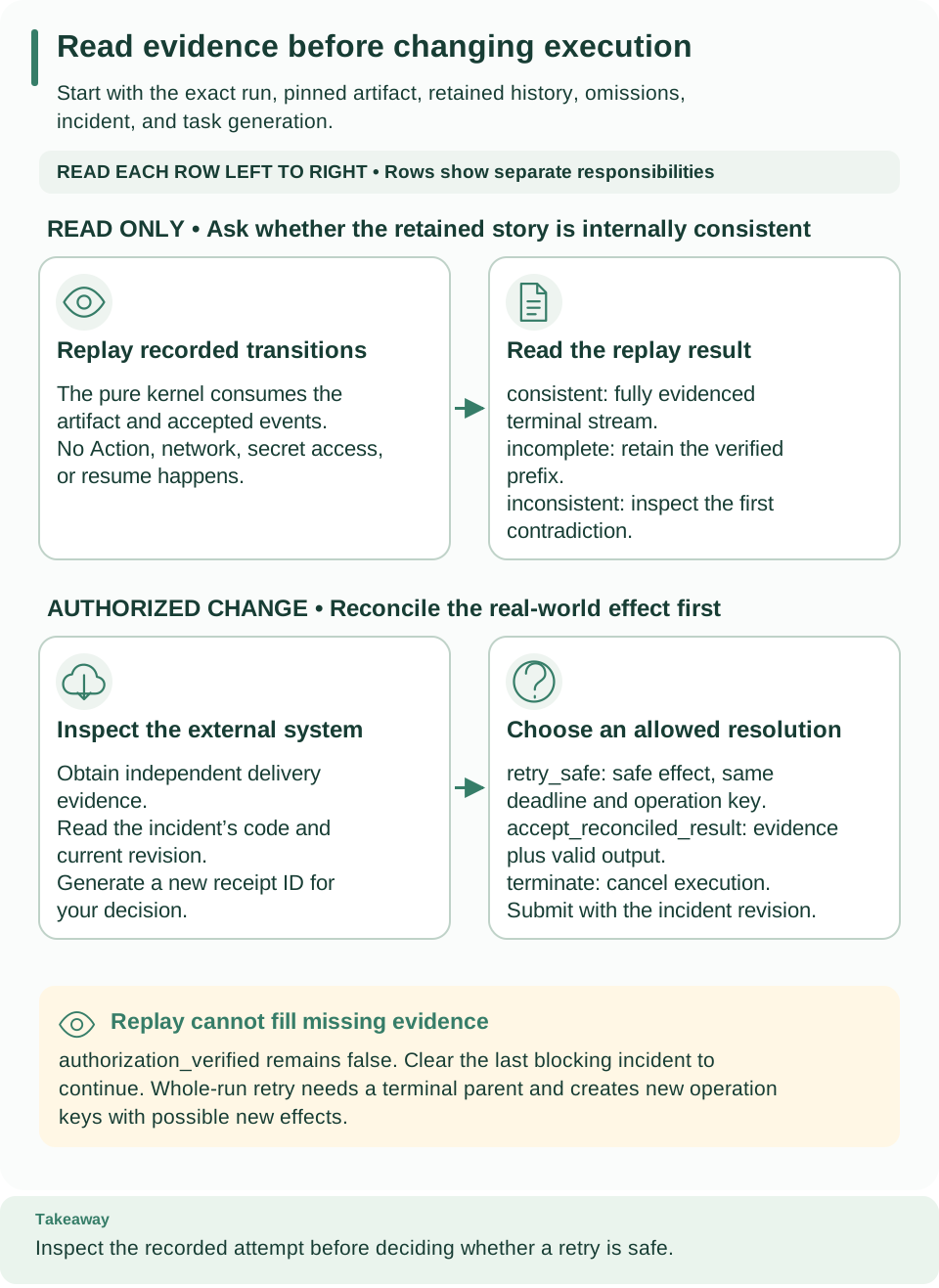
Follow the lower row left to right when you change execution: check the external system first, then submit a decision protected by the current revision and a stable receipt ID. The upper replay row is useful inspection, but it cannot retry an action or clear an incident. Open diagram at full size
Three actions, three meanings:
| Action | Changes | Use it when |
|---|---|---|
| Resolve an incident | The same run continues, or stops | One step's outcome is uncertain and you can decide it |
| Cancel a run | The run stops; work already sent elsewhere may continue | The execution should not go on |
| Retry a run | A new run starts, linked to the finished one | A finished run must be done again; it may repeat external effects |
Resolve an incident
Run the commands with a saved platform and workspace from weave auth setup (see
how remote commands choose a platform).
Saved platforms are new in 0.1.0a7; with an alpha6 or earlier CLI, these
commands use explicit mode.
-
Spot the blocked run. In Studio, Runs shows the status "On hold" for it, and its detail shows "This run stopped at STEP." with the incident's code, where STEP is the step's ID. Studio shows this state but has no controls to resolve an incident, cancel a run, or retry it; use the CLI commands below or the API. From the CLI, list the run's incidents:
# List the incidents of one run, active and closed.
weave runs incidents run-list RUN_ID --output json
Expected: a page whose
itemsinclude the active incident withid,revision,node_id,generation,code, and"status": "active". Record them.weave runs incidents listshows every incident in the environment.The
codesays what happened:codeWhat happened Decisions that fit WV-TASK-AMBIGUOUSAn attempt of an Action that is not safe to repeat ended without a usable result, so its outcome is unknown Check the other system, then accept_reconciled_resultorterminateWV-TASK-RETRIES-EXHAUSTEDA safe-to-repeat Action used every automatic attempt, or no time was left for another Fix the cause, then retry_safebefore the Action's deadline, orterminateWV-TASK-DEADLINENobody claimed the task before its deadline Its time budget is spent, so another attempt cannot run: usually terminate, then check that an executor or worker is running and start a linked retryWV-TASK-FAILEDThe executor or worker reported a failure retry_safeonly when the side effect is safe to repeat; otherwise reconcile orterminateThe Action's side effect decides what is safe. Studio shows it as Side effect, under What this action needs in the Call an action step's inspector, when connected; from the CLI, read
spec.sideEffectinweave definitions export ACTION_VERSION_ID --collection actions --output json. -
Understand which attempt is involved. Read the run's history and the worker recovery rules to see which action and attempt are uncertain.
-
Check the external system. Use that system's own authorized procedure. Weave does not look up a payment, message, or database change for you.
-
Choose a decision:
Decision Choose it when Requirements retry_safeThe action is safe to repeat Only for actions declared read_only,idempotent, oridempotency_keyaccept_reconciled_resultIndependent evidence shows the result An outputvalid for the action's pinned output schema, and anevidence_referenceterminateThe run should stop Nothing else -
Write the decision. Generate a new UUID for
receipt_id; reusing one from another decision conflicts:Save this as
resolution.jsonwith that UUID, your real evidence reference, and the verified result in place of the output (42only fits an output schema that accepts that number): -
Submit it with the revision you just read:
# Resolve the incident; the revision guards against a concurrent decision.
weave runs incidents resolve INCIDENT_ID --revision REVISION --request resolution.json --output json
Replace
REVISIONwith the incident'srevisionfrom step 1.Expected: the incident with
"status": "resolved"and yourresolution. -
Read the incident and the run again. The decision is audited, but another active incident or a deadline may still block the run. If the response was lost, resend the same receipt, body, and revision; if another decision won (HTTP 409), read the incident again before deciding anything.
Cancel a run
Cancellation stops scheduling and revokes leases at once. It cannot recall work already sent to an external system.
# Write the audited reason, then cancel the run.
printf '%s\n' '{"reason":"operator decision"}' > cancel.json
weave runs cancel RUN_ID --request cancel.json --output json
Expected: the cancelled run. Check external_effects_may_continue in the
response: when true, work already issued may still finish elsewhere. Cancelling
again returns the same cancelled snapshot without a new event; a run that already
ended in another state cannot be rewritten.
Start a new run from a finished one
A retry of a whole run creates a new execution with new operation keys. The original run, its outputs, and its history are unchanged.
- Check that the original run has finished. Retry needs a terminal parent.
- Find the activation and the input. Read the original run with
weave runs read RUN_ID --output json. Copy itsactivation.id, or a newer activation's ID fromweave definitions activations list --output json, and, to repeat the same data, itsstate.input. -
Write the start request. Save this as
new-run.json, replacing the activation UUID and the input: -
Start it with an idempotency key:
# Start a new run linked to the finished one; the key makes a resend safe.
weave runs retry RUN_ID --idempotency-key retry-123 --request new-run.json --output json
Expected: a new run whose
parent_run_idis the original run. Reuse the same key only to resend this exact request.
The new run is checked against the current definition, release, and connection bindings, and it may cause external effects again.
Decisions and endpoints in detail
All paths are under
/api/v1/tenants/{tenant}/projects/{project}/environments/{environment}.
Authorization uses your current scoped capabilities, even when a receipt is
repeated. Platform administration alone grants no execution rights.
| Request | CLI | Capability | Result |
|---|---|---|---|
GET /runs/{run}/incidents |
weave runs incidents run-list |
incident.read |
Incident views, including closed history |
GET /incidents |
weave runs incidents list |
incident.read |
Incidents across the environment |
POST /incidents/{incident}/resolve |
weave runs incidents resolve |
incident.resolve |
An immutable, revision-fenced resolution |
POST /runs/{run}/cancel |
weave runs cancel |
run.cancel |
Terminal cancellation with the external-effects flag |
POST /runs/{run}/retry |
weave runs retry |
run.retry and normal start admission |
A new run linked by parent_run_id |
Resolve requests. Send If-Match with the positive revision from the read,
and a JSON body with a UUID receipt_id, a kind, and a nonblank reason (at
most 2,000 characters). Only accept_reconciled_result takes an output;
retry_safe and terminate reject any output, even null. A reconciled output
is checked against the 1 MiB payload limit before anything is stored. The same
person resending the same request with the original revision gets the original
receipt; a different request with that receipt ID conflicts; two competing
receipts for one revision cannot both win. Authority is checked before a resend
is honored, so removing a grant also stops resends.
retry_safe may allow one attempt beyond the exhausted automatic budget, with
the original operation key and the remaining original action and run deadlines.
It neither resets the automatic budget nor extends a deadline. For an action whose
side effect is not safe to repeat, it fails with HTTP 409
WV-RUNTIME-RECONCILIATION_REQUIRED.
accept_reconciled_result needs an explicit output and a nonblank evidence
reference. An explicit null is valid only when the pinned output schema allows
it. The output is validated against the exact pinned schema and dependency bundle;
Weave performs no external lookup or effect itself.
terminate cancels the run: scheduling stops and leases are revoked
atomically. The response sets external_effects_may_continue: true. Authentic
late completions for revoked generations may receive an immutable ignored
receipt; they never advance the run.
Several incidents. Each resolution stores the actor, reason, kind, evidence, time, and receipt. Independent incidents on different nodes or generations share a run-wide suspension barrier: authenticated results that arrive meanwhile are kept, and the run continues once, after the last blocking incident clears. An expired overall or wait deadline can still end a suspended run; reconciliation cannot bypass it.
Cancel and retry requests. Cancel takes {"reason": "..."} (nonblank, at most
2,000 characters). Retry takes a normal start request, {activation_id, input}
with optional correlation_key and business_key, and requires an
Idempotency-Key header.
Older operator commands. weave incident list RUN_ID,
weave incident resolve INCIDENT_ID --revision N --request FILE,
weave run cancel RUN_ID --reason TEXT, and
weave run retry RUN_ID --idempotency-key KEY --request FILE remain available.
They do not use saved platforms: they need --environment-url (or
WEAVE_ENVIRONMENT_URL) set to the full scoped environment URL and a
WEAVE_ACCESS_TOKEN. They require TLS outside loopback, refuse redirects, and
print JSON without the token.
Forward migration and compatibility
This section is for administrators who apply database migrations.
Revision 0010_incidents adds the scoped incidents,
incident_resolution_receipts, and run_retry_links tables. The kernel and its
accepted events stay authoritative; the new tables are projections kept in sync
in the same transaction, and no read repairs them.
- Existing active incidents are backfilled with deterministic run and key identities and revision 1, keeping node, generation, and code, with no invented actor or evidence.
- Older suspended runs without that information become
@legacy, with unknown node and generation, and support only termination. - Previously closed incidents stay in the immutable
run_events; they are not reconstructed as audited resolution rows. Existing run and event JSON is unchanged.
The migration identity needs its normal DDL and table privileges plus explicit catalog-only enumeration authority. Before migrating, the function owner, or an administrator who can grant its privileges, must run:
Never grant this to the application role. Without it, the migration fails
clearly. It lists tenant IDs through the existing fixed-search-path
SECURITY DEFINER function and backfills under each tenant's forced row-level
security. It never changes role membership, membership options, business-table
policies, or the function's owner or PUBLIC privileges. Migration and backfill
are transactional; there is no destructive downgrade or startup repair. Follow
the upgrade procedure before changing the running
version.
Runs with unavailable legacy evidence
Some runs created before the current admission policy cannot be shown safely.
- Reads. Normal reads of such uncertain legacy runs return HTTP 409
WV-LEGACY-UNAVAILABLEwith a safe run ID, status, and omission metadata for/state; no fake redacted state is returned. New runs carry the server-ownedadmission_policy: classified-v1, which records policy provenance, never caller identity or authorization. Older unmarked artifacts stay compatible. - Cancellation still works. It replaces only the mutable execution snapshot
with an explicit
unavailableterminal state, using the kernel's existing cancellation and revocation. The acknowledgment contains the ID, the cancelled status, the accepted sequence, the unavailable omissions, andexternal_effects_may_continue, and no activation, request, source, or payload. Repeating it returns the same acknowledgment. Cancellation never parses legacy activation, request, or artifact metadata, so malformed data cannot block it. Earlier history stays untouched, so replay reports incomplete evidence. An unavailable state cannot continue normally. - Deadlines still apply. Persisted overall timeouts stay enforceable using
database time and their issued deadline. Structurally verified signal deadlines
can also end the run when no receipt was accepted strictly before them; an
earlier receipt never causes unsafe continuation. A bounded structural check
records
terminal_signals_verified. Unverifiable artifacts support only overall timeout and cancellation. External effects may continue after these controls, and no historical payload is migrated or deleted. - Every access re-checks the artifact. The pinned artifact is validated against the current structural and classification policy before the provenance marker is trusted, so the marker cannot bypass corrected admission rules. Invalid retained artifacts follow the unavailable, policy-block, and safe terminal-control paths even when an earlier build marked them.
Next steps
- Recorded history and offline replay: read what happened before you decide.
- Implement and operate a worker: leases, attempts, and why an outcome can be uncertain.
- Manage executions and business cases: pause, resume, archive, and purge runs.
- Troubleshooting: locate the failing stage first.
Troubleshooting
| What you see | Why | What to do |
|---|---|---|
HTTP 409 WV-RUNTIME-RECONCILIATION_REQUIRED |
retry_safe was used for an action that is not safe to repeat, the incident is not tied to an action (only terminate works), or a reconciled result lacks output or evidence_reference |
Reconcile externally and use accept_reconciled_result with both fields, or terminate |
HTTP 409 WV-INCIDENT-REVISION |
Another decision changed the incident since you read it | Read the incident again; decide only if it is still active |
HTTP 409 WV-RUNTIME-STATE |
The incident is no longer active, or no failed task matches it | Read the run and its incidents again |
HTTP 409 WV-RUNTIME-DEADLINE on retry_safe |
The action's original deadline has passed | Use terminate, then start a linked retry of the whole run |
HTTP 422 WV-RUNTIME-OUTPUT |
The reconciled output does not match the action's pinned output schema or exceeds the payload limit, or an output was sent with retry_safe or terminate |
Fix the output to match that schema; leave output out for the other decisions |
HTTP 409 WV-INCIDENT-RECEIPT-CONFLICT |
You reused a receipt_id with a different body or revision, or another person used it |
Resend the original request unchanged, or generate a new receipt_id for a new decision |
| The run stays suspended after a resolution | Another incident is still active, or a deadline applies | List the run's incidents again and resolve each active one |
retry is rejected, for example with HTTP 409 WV-RUNTIME-STATE |
The parent run has not finished, or the start request is invalid | Wait for the run to finish, or cancel it first; check the input |
external_effects_may_continue: true after cancel |
Work was already sent to another system | Check that system and compensate there if needed |
HTTP 409 WV-LEGACY-UNAVAILABLE |
An older run's state cannot be shown safely | Cancel it if needed; replay reports its evidence as incomplete |