Remote worker protocol
A worker is your own process that asks Weave for tasks, runs your business code, and reports each outcome. This reference describes the HTTP protocol between a worker and the platform: the endpoints, the lease rules, and what happens on retries, cancellation, and lost responses. It is for integration developers who write their own task transport or diagnose lease and completion behavior.
Building your first worker? Follow the worker guide
instead: it explains the example handler, the roles involved, and the
deployment order. The Python SDK's Worker and WorkerTransport implement
everything on this page for you. Before adding workers, complete the
standalone tutorial or the
local platform setup.
Need to call a REST API? You may not need a worker at all: the built-in HTTP connector calls it without code.
The task lifecycle
| Term | Meaning |
|---|---|
| Release | An immutable build identity (an image digest) and the capabilities it declares, admitted by a deployer |
| Instance | One registered running process, owned by the authenticated worker principal |
| Task | One external operation that a workflow's Call an action step prepares |
| Lease | Time-limited permission for one instance to attempt that task |
| Generation | The attempt number; recovery increments it so a stale attempt loses authority |
| Operation key | A stable idempotency key for the external system, the same across attempts of one task |
| Completion ID | Your identifier for one submitted outcome and its replayable receipt |
| Receipt | The platform's durable acknowledgment that it accepted that outcome |
The normal order is admit release → register instance → claim → heartbeat while working → complete or fail. Registering creates no task. A claim returns an empty list while no eligible work exists. When the handler needs a secret, it asks for a separate, authorized credential lease.
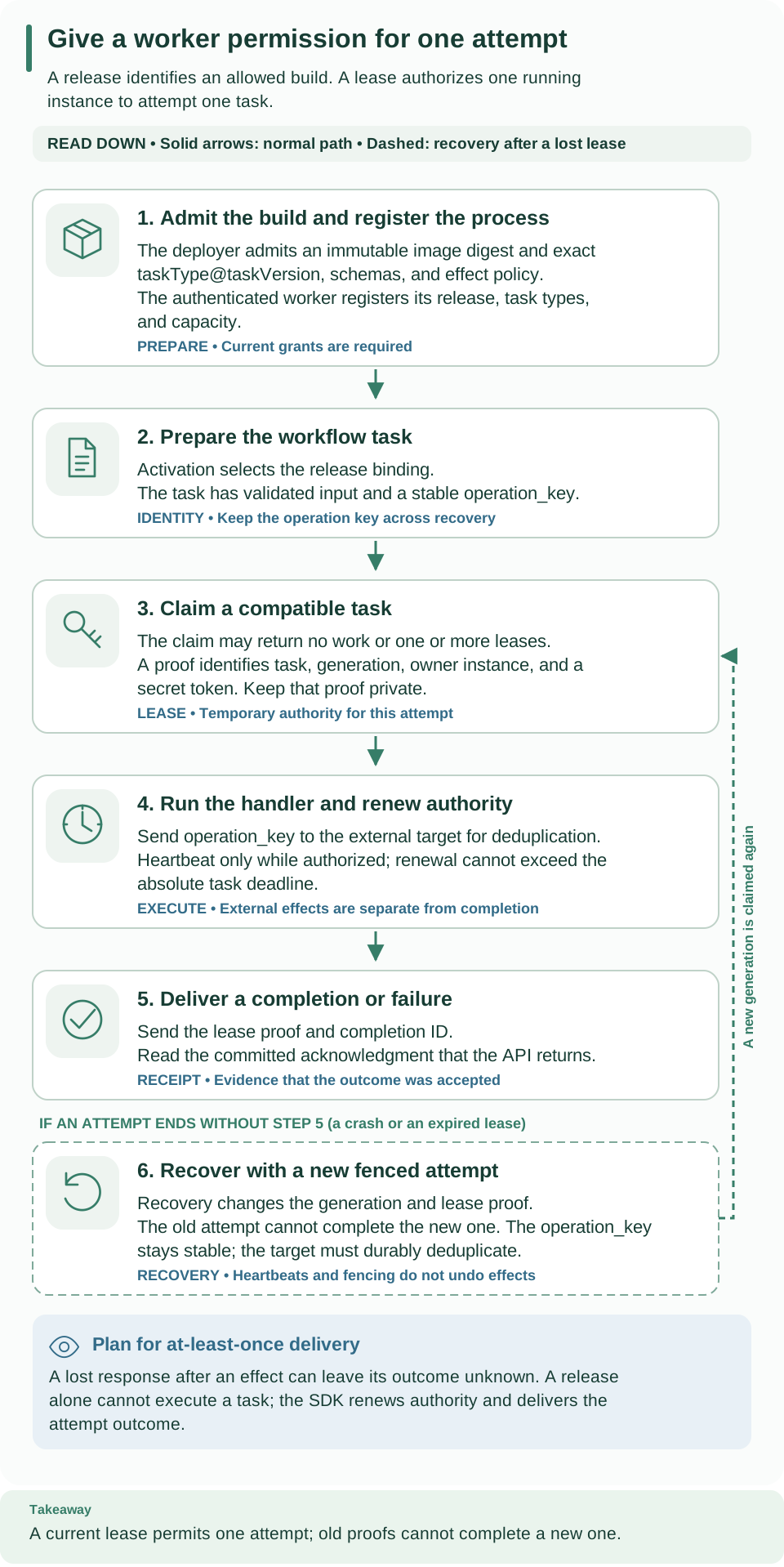
Read down from admission and registration through claim, heartbeat, and outcome. The dashed path at the bottom is recovery: it creates a new generation and lease proof but keeps the operation key, so the external target must use that key to avoid repeating an effect. Open diagram at full size.
Authentication and endpoints
The worker example imports only the worker SDK and an HTTP client. It receives no database or administrator credentials.
- A separately provisioned identity-provider client obtains an access token for
the platform's API audience (
weave-apiin the local tutorial). The API verifies it like any other token and looks up the linked Weave principal. - That principal needs the
workerrole in the environment. The role grants no authoring rights, and identity-provider roles alone grant nothing.
Every path below is relative to
/api/v1/tenants/{tenant}/projects/{project}/environments/{environment}, and
every request needs a bearer access token plus a current grant in that scope.
| Operation | POST path | Body and result |
|---|---|---|
| Admit an immutable release | /worker-releases |
A deployer sends image_digest, the exact capabilities, and optionally credential_capabilities and trusted connector_bindings; returns the release ID |
| Register an instance | /workers |
release_id, the exact task_types, and capacity; returns a worker ID owned by the authenticated principal |
| Claim | /tasks/claim |
worker_id and limit (1 to 100); returns zero or more TaskLease values |
| Renew | /tasks/heartbeat |
The current LeaseProof; returns the lease with its new expiry |
| Complete | /tasks/complete |
lease, a unique completion_id, and an output that matches the schema; returns the committed receipt |
| Fail | /tasks/fail |
lease and an error with completion_id, a bounded code, and an outcome (not_started, failed, or unknown) |
| Credentials | /tasks/credentials |
A live lease, the bound connection_revision_id, and a slot; returns a short-lived lease with Cache-Control: no-store |
For example, after a deployer admits the example release, registration sends:
{
  "release_id": "<the admitted release UUID>",
  "task_types": ["example-record@1.0.0"],
  "capacity": 1
}
Replace the placeholder with the release ID that admission returned. Save the
registration result's id as the worker ID; a claim body is then
{"worker_id": "<that instance UUID>", "limit": 1}. Never build a lease proof
yourself: send back the exact proof from the claim response for renewals and
outcomes.
Keep the lease proof private. LeaseProof holds the task ID, the
generation, the owner instance ID, and a secret token; never log it or store it
in ordinary telemetry. TaskLease also carries the immutable input, the
stable operation_key, the capability, the admitted worker_release_id, the
lease expiry (expires_at), and the absolute deadline. Built-in connectors
follow the same rules, but their invocation details are private to the platform.
SDK runner and token lifetime
- Runner. Use
WorkerTransportwith an authenticatedhttpx.AsyncClient, andWorkerwith handlers keyed by exacttaskType@taskVersion. The runner limits concurrency, renews leases, and cancels a handler when authority or the deadline is lost. - Shutdown. SIGTERM asks the worker to drain. Supervise the process with an outer time limit for shutdown.
- Tokens.
WorkerTransportdoes not renew tokens. The example acquires one token at startup and is deliberately finite: it stops claiming 210 seconds before the token expires, which reserves its 180-second task contract plus a 30-second margin, and a final 15-second margin bounds the whole invocation. A token too short for that policy fails before any claim. A supervisor then starts a new invocation with fresh credentials. This policy fits the example's declared task timeout, not every handler.
Retries and lost responses
Delivery is at least once. Pass operation_key to the external target, and
let the target keep its own durable idempotency receipt. The key stays the same
when recovery creates a new generation.
- A stale generation or proof cannot complete a newer attempt.
- Sending an accepted
completion_idagain with the same body replays its receipt; changing the output conflicts (HTTP 409,WV-COMPLETION-CONFLICT). - A lost completion response is ambiguous. Do not run the handler again to compensate.
Example. The target records a customer, and the worker crashes before Weave
accepts the completion. Recovery issues generation 2 of the same task. Its
handler sends the same operation_key, so the target returns its original
receipt. Lease fencing stops generation 1 from advancing generation 2's work;
only the target's own deduplication prevents a duplicate customer.
Capacity rejections are the only automatic retries. HTTP 429 with exactly
WV-REQUEST-CAPACITY or WV-OPERATION-CAPACITY means the platform rejected
the request before admitting it:
| Request | What the SDK does |
|---|---|
| Claim | Returns no leases; the worker polls again later without cancelling active handlers |
Heartbeat through Worker |
Retries until the current lease expires, waiting 50, 100, and 200 ms, then 250 ms each time; renewal continues while completion awaits acknowledgment |
Context or credentials through the owning Worker handler |
Retries known capacity rejections while the lease remains valid; heartbeats may extend the lease, but never the task deadline or handler budget |
Direct WorkerTransport.context or .credentials |
At most 3 attempts in total within one second of the first rejection |
Direct WorkerTransport.heartbeat |
At most 3 attempts in total, waiting 50 and then 100 ms, within one second of the first rejection |
Complete or fail through Worker |
Retries within the task deadline while the owning worker's lease watchdog remains active, waiting 50, 100, and 200 ms, then 250 ms each time |
Direct WorkerTransport.complete or .fail |
At most 48 attempts within ten seconds of the first rejection, using the same backoff; the initial request uses the caller's HTTP timeout |
The lease and deadline watchdog can stop these retries sooner. Every retry sends identical bytes (proof, completion ID, and payload), and the handler never runs again. Any other 429, authorization errors, server errors, disconnects, timeouts, and malformed successful answers fail without automatic retry. Context and credential retries require alpha13 or newer. These retries cannot resolve an ambiguous outcome or renew expired authority. The extended settlement window belongs to the exact lease proof and execution task. The owning handler has an explicit window that tracks the currently validated lease; an unrelated child task cannot inherit that authority. The worker's renewal task owns a separate window that ends at the current lease expiry. Unrelated calls and other child tasks retain the direct transport limits. A successful heartbeat received before expiry can extend the current lease, but never the task deadline.
Effects and incidents. Only effects declared safe are retried, within the pinned attempt and deadline policy. An ambiguous non-idempotent effect raises an incident instead. Weave does not promise exactly-once external effects. In the local acceptance test, the target's in-memory receipt map survives API and worker restarts; a production target must keep receipts for its whole replay window.
Credential leases need every authorization at once: the release's explicit opt-in, the administrator's release, connection, and capability grants, the connection bound in the activation, a live lease, and the operator's grant from the secret handle to its provider. Nothing a host or worker sends can choose a secret-provider locator, a destination policy, or native executor authority.
How the crash scenario is tested. The crash launcher lives under
tests/e2e/support/ and is copied only into its own test container. It records
a private lease proof after the receiver accepts the effect, then exits before
completion. Production source and images have no fault switch, and ordinary SDK
handlers have no such hook.
Cancellation and suspended branches
A failed branch cancels its siblings. When a structured branch fails, the platform cancels pending work and revokes the sibling leases already issued, in the same run transaction.
- A valid proof for the exact generation that this control failure revoked, if
it is still live, can submit one immutable
ignoredreceipt. It records the delivery without accepting output or advancing the run. Identical retries replay it; a different payload fails. - Expired attempts, forged proofs, unrelated stale generations, and timeout revocations do not get this exception. Heartbeats and credential requests stay denied after revocation.
- The SDK treats
ignoredas a committed receipt and never reruns the handler.
A recoverable failure suspends the whole run. Other attempts already in flight can still record authenticated completion receipts before their expiry and deadline. Their outputs wait until every blocking incident is resolved: joins, new branch starts, and retry claims cannot cross this barrier. Resolving one branch never clears a sibling's incident. Parallel concurrency counts every started, unfinished direct branch, including nested work, signal waits, and retries, and survives restarts.
Classified output rejection
Secret output is rejected, not stored. When an ordinary output contains a
value for a field marked x-secret or writeOnly, the platform opens one
controlled incident and returns a rejected receipt.
- The receipt keeps the task, generation, completion ID, time, and
reason_code; itsaccepted_output_hashis null. - No raw output, response representation, submitted key, or digest of the raw output is stored. Built-in connectors use the same boundary, and a classified late output gets the same safe rejection without advancing a finished run.
- Every retry of that receipt, after the current authority and original proof ownership are checked, returns the same rejection, even with different content. It cannot become accepted, and the platform does not compare rejected payloads.
- A new valid result needs a new operation allowed by the incident and lease
rules. Accepted
completed,failed, andignoredreceipts keep their exact payload comparison. - The SDK treats
rejectedas a delivered outcome and never reruns the handler because its output was rejected.
Older runs with uncertain secret handling are blocked. Such runs cannot
issue new work, resume, lease credentials, or accept ordinary outcomes. Trusted,
bounded scanners record only immutable run_policy_blocks entries and fence
eligible attempts as policy_blocked, atomically.
- Candidate searches skip these entries before applying their limits, so later valid work keeps moving across restarts.
- Public reads and rejected requests never repair data. Blocks are never cleared automatically, grant nothing, and do not prove that historical data was repaired.
- A later cancellation cannot turn a policy fence into an
ignoredreceipt.
Historical receipts with unavailable payload evidence
After policy blocking, the original proof owner, with current authority, can still replay an existing receipt for a task, generation, and completion ID:
- An earlier
completed,failed, orignoredreceipt returnsUnavailableCompletionReceipt: the original identity, accepted time, and status,unavailable: true,payload_match: "unavailable", and an explicit omission of/accepted_output_hash. It contains no output or hash. - This acknowledges the historical receipt only. It neither accepts nor compares the newly submitted body; a changed body gets the same answer and is neither hashed nor stored.
- An earlier
rejectedreceipt is already safe and returns unchanged, with its original reason. - A new completion ID stays denied, and revoked grants, a revoked worker, or another owner still deny the replay. Receipts and events are never rewritten.
CompletionAcknowledgment is the public union of both receipt types. The SDK
keeps the concrete type and the unavailable flag, and completes delivery
without rerunning the handler.
Troubleshooting
| What you see | Why | What to do |
|---|---|---|
Claims always return [] |
No activated workflow has a task for this release and its task types yet, or all tasks are taken | Check that the activation pins this release and that a run reached the Call an action step |
HTTP 401, WV-UNAUTHENTICATED |
The worker's token expired, has the wrong audience, or its identity is not linked | Get a fresh token; ask an administrator to link the worker's identity |
HTTP 403, WV-FORBIDDEN |
The principal lacks the grant for this operation in this environment, or the worker ID belongs to another principal | Ask for the worker role; use a worker ID that this principal registered |
HTTP 409, WV-LEASE |
The lease expired, a newer generation exists, or the worker instance is unknown or revoked | Stop the handler and never resend with another proof; recovery issues a new attempt. After a revocation, register a new instance |
HTTP 409, WV-COMPLETION-CONFLICT |
A completion_id was reused with a different body |
Resend the exact original body, or use a new completion ID only for a genuinely new outcome |
HTTP 409, WV-RELEASE-CONFLICT |
Admission reused an image digest with a different release request | Build a new image, or resend the exact original request, which returns the existing release |
HTTP 429, WV-REQUEST-CAPACITY or WV-OPERATION-CAPACITY |
The platform is at capacity | Nothing; the SDK retries within the limits above |
A rejected receipt and a new incident |
The output held a value for a field marked x-secret or writeOnly |
Change the handler so it never returns those values, then resolve the incident; see classified output rejection |
Next steps
- Build, deploy, and observe a worker with the worker guide.
- See how leases and retries fit the whole platform in concepts.
- Resolve the incidents that a failed task opens with incident operations.
- Look up each worker operation's schema in the full API reference.